

Quick Guide
Reiki is not a treatment for depression. The National Center for Complementary and Integrative Health says Reiki has not been clearly shown to be effective for any health-related purpose, that there is no scientific evidence for the energy field it describes, and that no harmful effects have been reported. Depression is a medical condition that the National Institute of Mental Health says is treated with talk therapy, medication or both. A Reiki session may still be a calm, comforting hour, and it can sit alongside care as comfort, never instead of it. This guide explains what the evidence supports, how care options compare, four checks before adding a session, and when to get help right away.
Depression and Reiki are often written about together, usually by people selling one to treat the other. That pairing needs care. Depression is a medical condition with recognised treatments and real consequences when it goes untreated. Reiki is a relaxation and spiritual practice with no evidence that it treats anything. Both statements are true, and holding them together is the whole task of this article.
What follows is not an argument against Reiki. It is a plain account of where the evidence sits, how depression is actually treated, how to add a session safely if you want one, and how to tell an honest practitioner from one who is overselling. It ends with the fastest routes to help if you need it now.
What the evidence says about Reiki and depression
The NCCIH overview of Reiki is the clearest summary available. It says Reiki “hasn’t been clearly shown to be effective for any health-related purpose”, that there is no scientific evidence for the energy field it describes, and that no harmful effects have been reported. Studies that have looked at mood have generally been small, with inconsistent results, and they cannot support the claim that Reiki treats a depressive disorder.
It helps to keep three things separate. A person can truthfully say “I felt calmer after the session”; that is an experience. Saying “blocked energy caused my depression” adds an explanation the experience does not support. Saying “Reiki is treating my depression” adds a medical claim the research does not support. Testimonials mix all three, which is why they are persuasive and why they are not evidence. Our article on what Reiki research can and cannot show explains the study designs behind that conclusion.
Three things to keep separate
- ExperienceHow the session felt: calm, warm, emotional, or nothing much. This is real and yours to report.
- ExplanationWhy it felt that way. “A quiet hour with no demands” is a fair explanation. “Energy was rebalanced” is a belief, not a finding.
- TreatmentWhether the condition is improving because of the session. Only proper assessment over time can answer that, and Reiki has no evidence for it.
What depression is, and what it is not
The NIMH guide to depression describes a condition that affects mood, thinking, sleep, appetite, energy and daily functioning, lasting most of the day, nearly every day, for at least two weeks. Genetic, biological, environmental and psychological factors can all contribute. It is not caused by weakness, a failure to forgive, unresolved past lives or an energy blockage, and it does not lift because someone tries harder. Recurring symptoms are a feature of the illness, not a sign that you practised a technique incorrectly.
That framing matters because a spiritual explanation can quietly become blame. If a practitioner suggests that your depression persists because you are resisting, unready or holding on to something, that is a story that keeps you paying and keeps you from care. You do not need to find a hidden cause before asking for help.
Care options compared
| Option | What it is for | What the evidence says | Role alongside other care |
|---|---|---|---|
| Talk therapy | Treating depression; changing patterns of thinking and behaviour | Established treatment (NIMH) | Often first-line; can be combined with medication |
| Medication | Treating moderate to severe depression | Established treatment (NIMH); needs a prescriber and follow-up | Often combined with therapy; never changed on a practitioner’s advice |
| Meditation or mindfulness | Stress, anxiety and mood support | Modest, real benefits; not a treatment for disease; a minority report increased anxiety or low mood | A useful addition, not a replacement |
| Reiki session | Relaxation or spiritual practice | Not clearly shown effective for any health purpose; no harm reported | Optional comfort beside care; never instead of it |
| Exercise, sleep, daylight, people | Everyday supports for mood | Widely recommended as part of care | Alongside everything else |
The table is not a ranking of what you should enjoy. It is a ranking of what you should rely on. Talk therapy and medication carry the treatment load. Meditation, movement and social contact support it. Reiki, if you like it, is a pleasant addition. Our article on mind-body approaches alongside therapy goes further into how these fit together.
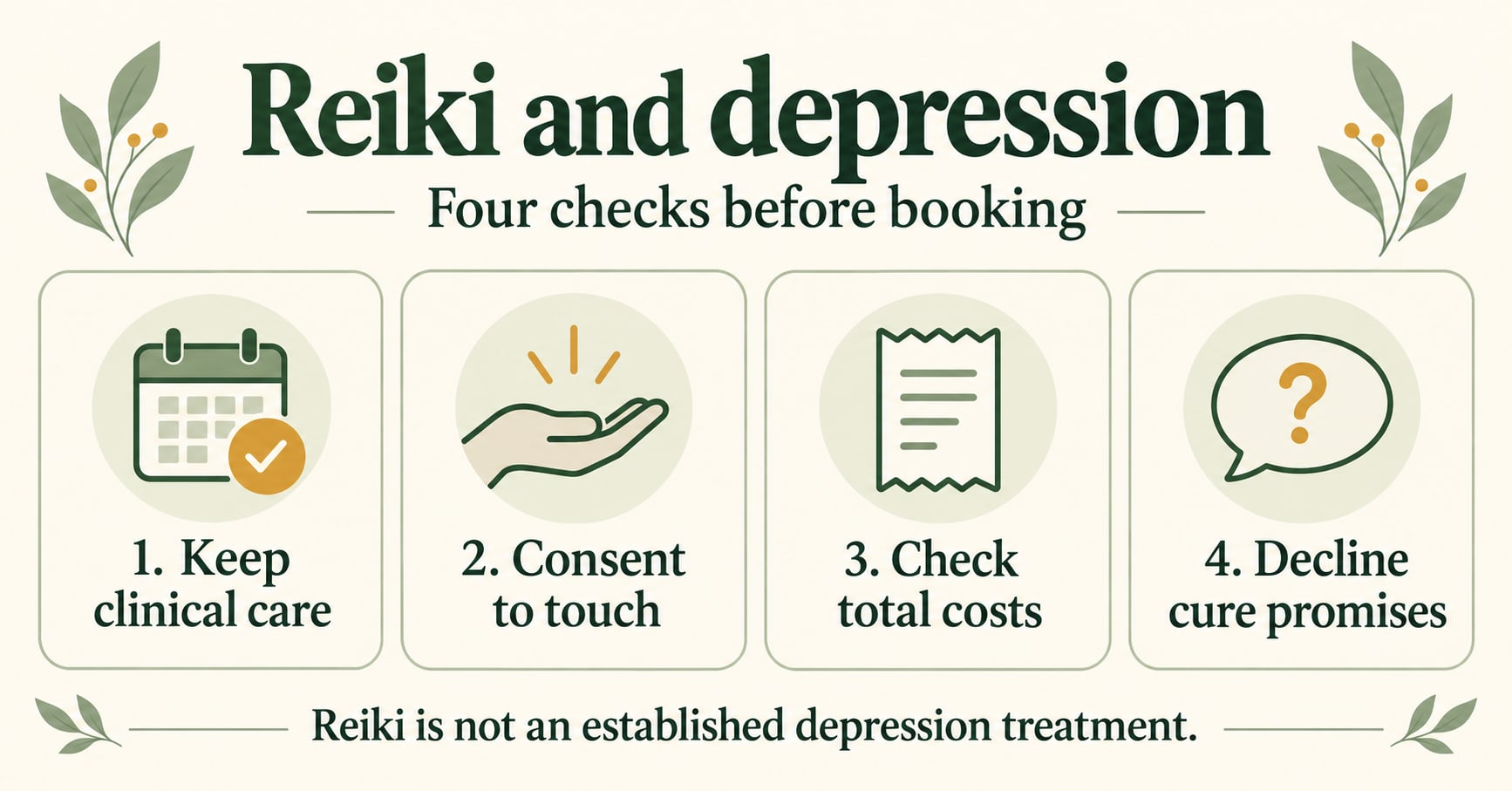
Four checks before adding a session
- Keep clinical care in place. Keep every appointment and every prescription. Tell your doctor or therapist that you are trying Reiki; there is no reason to hide it and every reason to have it on record.
- Agree the format in advance. Ask whether hands touch the body or hover above it, whether a seated option exists, and how to stop. Consent to one element is not consent to everything.
- Confirm the total cost. Fee, length, cancellation policy and whether follow-ups are expected. Decide what you can comfortably spend before you are on the table, and decline packages.
- Refuse cure promises. Any suggestion that depression will disappear, that worsening symptoms are a “healing crisis”, or that recovery depends on buying more sessions is a reason to leave.
Safety and boundary note. Reiki is an optional relaxation or spiritual practice, not a treatment for depression. Do not start, stop or change medication or therapy because a practitioner says a blockage has cleared; discuss any change with the clinician responsible for your care. If you are thinking about suicide, feel unable to stay safe or are in a mental health crisis, call or text 988 in the US to reach the 988 Suicide and Crisis Lifeline, call 911 for an immediate life-threatening emergency, or contact your local emergency number outside the US.
Judging comfort without calling it a cure
After a session, the useful questions are ordinary ones. Was the room comfortable? Were your boundaries respected? Did you feel listened to without being interpreted? Were you pressured to rebook? Those answers tell you whether the hour was worth its price. What they cannot tell you is whether your depression is improving. A lift in mood for an afternoon is real and welcome, but it does not show which part of the experience caused it or that the condition is changing. Equally, feeling nothing does not mean you were resistant or spiritually unready. Both outcomes are normal, and both leave you free to stop.
- Do keep a plain record. Note the date, how you felt before and after, and whether you want to go again. Share it with your clinician if it is useful.
- Do treat the hour as rest. Rest is a fair thing to buy during a hard stretch, and a quiet room can be part of a week that also includes therapy and people.
- Do try the free version first. Our self-Reiki routine guide shows how a few minutes at home can offer the same calm at no cost.
- Avoid a practitioner who explains your depression. Diagnosis and explanation are not within their role, whatever their certificate says.
- Avoid changing treatment on their advice. Prescriptions and therapy plans are decisions for you and your clinician.
- Avoid treating worsening symptoms as progress. Feeling worse is a reason to contact your doctor, not to book again.
Talking to your clinician about Reiki
Many people worry that a doctor or therapist will dismiss them for trying a complementary practice. Most will simply note it and ask a few practical questions: what it costs, how often, and whether anyone has suggested changing your treatment. That last question is the one that matters to them. If you can say “no, and I would not”, the conversation is short. Bring notes on when your symptoms began, how they affect daily life, and any supplements or products a practitioner has recommended, since some can interact with medication. Our guide to Reiki safety and boundaries with medical care covers what to raise.
If cost, waiting lists, side effects or a bad past experience are making clinical care hard to reach, say so to a clinician directly. Those are practical problems with practical solutions, not reasons to rely on a comfort practice in place of treatment. Our article on psychology, spiritual practice and mental wellness looks at how the two can coexist, and our review of seven common Reiki claims is a quick check on any listing that mentions mood.
Key Takeaways
- Reiki is not a treatment for depression; NCCIH finds no clear evidence it helps any health condition and no reported harm.
- Depression is a medical condition treated with talk therapy, medication or both, and it is not caused by an energy blockage or a lack of effort.
- Keep experience, explanation and treatment separate; a calm hour proves only that the hour was calm.
- Before any session, keep clinical care in place, agree the format, confirm the cost and refuse cure promises.
- Worsening symptoms, thoughts of suicide or feeling unsafe need immediate help: call or text 988 in the US.
Related reading
- Reiki Research: What the Evidence Can and Cannot Show
- Reiki Safety, Risks and Boundaries with Medical Care
- Mind-Body Approaches Alongside Therapy: Evidence and Safety
- Psychology, Tarot and Mental Wellness
- 7 Common Reiki Claims: What to Check Before Booking
- Self-Reiki Practice: A Comfortable Routine and Clear Limits
- Using Meditation to Change Your Thinking
Frequently Asked Questions
1. Can Reiki treat depression?
No. The NCCIH says Reiki has not been clearly shown to be effective for any health-related purpose. Depression is treated with talk therapy, medication or both.
2. Is it safe to have Reiki while I am being treated for depression?
Generally yes. No harmful effects have been reported, and the main risk is using Reiki instead of treatment. Keep your care in place and tell your clinician.
3. Why did I feel better after a Reiki session?
A quiet hour with no demands can lift mood for a while. That experience is real, but it does not show that energy was involved or that the depression itself is improving.
4. Is depression caused by blocked energy or chakras?
No. NIMH describes genetic, biological, environmental and psychological factors. There is no scientific evidence for an energy field, and blaming a blockage can delay real help.
5. Should I stop my antidepressant if a practitioner says the block has cleared?
No. Never start, stop or change medication on a practitioner’s advice. Discuss any change with the clinician who prescribed it.
6. What should I ask before booking a session?
Whether hands touch or hover, whether you can sit, how to stop, the full cost and cancellation terms, and whether follow-ups are expected.
7. What is a healing crisis, and should I push through it?
It is a term some practitioners use for feeling worse after a session. Feeling worse is a reason to contact your doctor, not something to push through or treat as progress.
8. Should I tell my therapist or doctor that I am having Reiki?
Yes. Most clinicians will simply note it and ask whether anyone has suggested changing your treatment. Having it on record is helpful.
9. Does meditation help depression more than Reiki?
Meditation has modest, real evidence for stress, anxiety and mood, though it is not a treatment for disease and some people report increased anxiety. Reiki has no comparable evidence base.
10. Can I use self-Reiki at home during a low period?
Yes, as a comfort routine. A few quiet minutes with your hands on your chest or belly costs nothing. It should not replace therapy, medication, sleep or people.
11. How do I spot a practitioner who is overselling?
Cure promises, explanations of what caused your depression, pressure to buy packages, and any advice to change treatment are the main warning signs.
12. What if I cannot afford therapy?
Tell a doctor or clinic directly. Sliding-scale services, group programmes and community options exist, and cost is a practical problem to solve, not a reason to rely on Reiki alone.
13. When should I get help immediately?
If you are thinking about suicide, feel unable to stay safe or are in crisis. In the US, call or text 988, or call 911 for an immediate life-threatening emergency.
14. Is it wrong to enjoy Reiki if it does not treat anything?
No. Enjoying a calm hour or a spiritual practice is a fair reason to have one. The only rule is that it sits beside your care, never in place of it.
Final thoughts
Depression deserves care that matches the evidence: therapy, medication or both, plus the everyday supports of sleep, movement and people. Reiki can be a quiet hour inside that plan for anyone who finds it comforting, and there is nothing wrong with wanting one. Keep it in its place, keep your clinician informed, and if the weight becomes more than you can carry, reach for 988 or your local emergency number before anything else.
Evidence statements checked against the National Center for Complementary and Integrative Health and the National Institute of Mental Health on 30 September 2026.
This article provides an interesting perspective on depression and its causes. The mention of reiki as a treatment is intriguing, though I would like to see more scientific evidence supporting its efficacy.
I appreciate the holistic approach to treating depression presented here. The idea that energy blockages contribute to mental health issues is compelling, though more research would help in better understanding its practical applications.
It is valuable to consider non-medical treatments for depression, especially when conventional methods are not sufficient. However, I would recommend combining reiki with evidence-based practices to have a comprehensive treatment plan.
The article sheds light on the complex nature of depression and the potential benefits of reiki. Though reiki’s effectiveness might still be debated, exploring various treatment options is essential in addressing mental health comprehensively.
The emphasis on childhood development and its impact on long-term mental health is a point well taken. Exploring alternative treatments like reiki could be beneficial, but should be approached with caution and combined with other therapeutic methods.
The differentiation between chronic and situational depression is crucial in understanding the varied approaches needed for treatment. The discussion on reiki, while novel, might benefit from further empirical validation.