

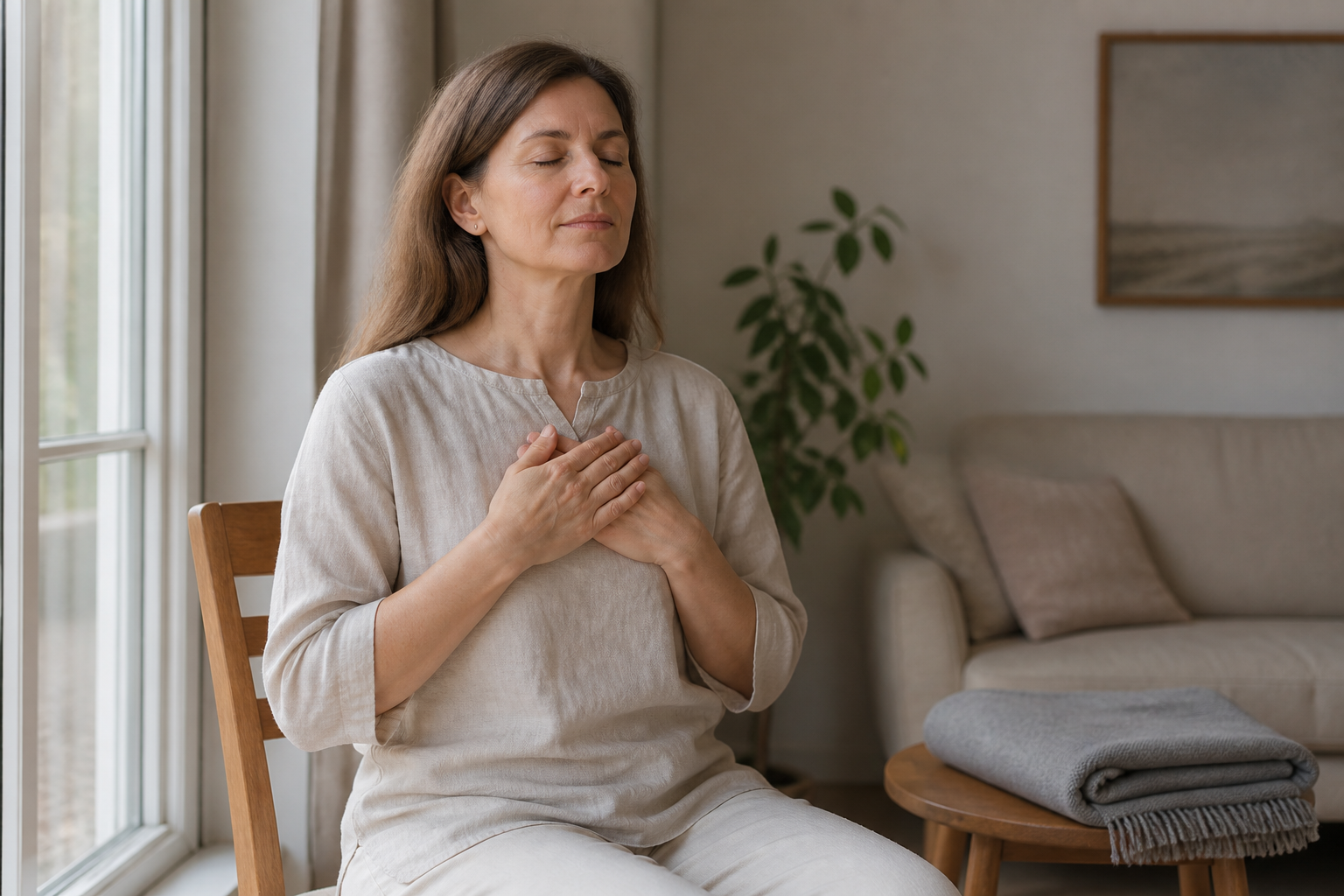
Quick Guide
Reiki is a hands-on or hands-near relaxation practice from early twentieth-century Japan. You can try gentle, optional hand-resting as a relaxation exercise at home; formal Reiki training traditionally includes an attunement. This guide walks through a 20-minute routine, the classic hand positions, what training looks like, and how to keep expectations honest. Reiki has not been clearly shown effective for health-related purposes, so it sits alongside proper care, never in place of it.
People arrive at Reiki from very different places. Some have had a session and want to recreate that calm at home. Some are curious about the tradition. Others have been told it will “clear blockages” or “heal” and want to know whether that is true before they spend money on a course. This guide is written for all three. It explains how to do Reiki in the practical sense, and it is equally clear about what the practice can and cannot claim.
What Reiki involves, and what it does not
In a Reiki session, a practitioner rests their hands lightly on or just above a person’s body, usually moving through a set sequence of positions. The person receiving it lies or sits quietly, fully clothed. Sessions typically last between 30 and 60 minutes. Self-Reiki is the same idea applied to yourself: your own hands, your own body, a quiet period of attention.
The traditional explanation is that the practitioner channels a “universal life energy” (the Japanese word rei-ki combines “spirit” and “life energy”). That explanation is part of the tradition, not an established fact. The U.S. National Center for Complementary and Integrative Health summarises the research plainly: Reiki has not been clearly shown to be useful for any health-related purpose, and there is no scientific evidence that the proposed energy field exists. Some people describe feeling relaxed, warm or calm during or after a session; others do not. Those experiences can be personally meaningful. It is not evidence that an illness has been treated.
Keeping those two things separate is the single most useful habit a beginner can build. You can enjoy the practice and still describe it accurately, and if you later work with other people, that honesty protects them as well as you. For a fuller look at how to read Reiki claims, see what research says about Reiki.
Do you need training to do Reiki?
You do not need a course to try gentle hand-resting for quiet reflection. Formal Reiki practice is traditionally taught by a teacher; these optional positions are not a substitute for that training and may not be comfortable or appropriate for everyone. Within the Usui tradition, though, Reiki is taught in stages, and most practitioners consider the first stage the proper starting point if you want to work on others.
The three traditional Reiki levels
- Level 1 (Shoden)Usually a one- or two-day course. Covers history, the hand positions, self-practice and treating family or friends. Includes an attunement ceremony.
- Level 2 (Okuden)Introduces the three traditional symbols, including the one used for “distance” practice, and treating people outside your immediate circle.
- Master / Teacher (Shinpiden)Trains you to give attunements and teach. Often a longer commitment, sometimes with an apprenticeship period.
Levels, names and content vary between lineages. A lineage certificate is not a medical qualification. Training systems and local business or professional requirements differ; check those that apply where you intend to practise.
An attunement (reiju in Japanese) is a short ceremony in which a teacher performs a set of hand movements and symbols over a student. Traditionally it is said to “open” the student to Reiki. Whether you find that meaningful is a personal matter. Practically, an attunement is what a lineage uses to mark that you have been taught, but it does not establish clinical competence or demonstrate a healing ability. If you are considering a course, preparing for a Reiki attunement explains what to expect on the day.
Setting up a simple self-practice
You need very little. A chair or a place to lie down, ten to twenty minutes when you will not be interrupted, and a room that is comfortably warm. Turn your phone to silent rather than off if you have caring responsibilities. Music or objects are optional preferences, not evidence of added health benefit. Avoid candles or anything else that introduces unnecessary risk or distraction.
Choose a regular time. Many people practise first thing in the morning or just before bed, because that is when a quiet routine is easiest to keep. Choose a duration and frequency that fit your comfort and responsibilities; a short practice can be enough, and you do not need to maintain a daily streak.
The basic self-Reiki hand positions
The Usui tradition teaches a sequence of positions that move from the head down the front of the body. Hands rest lightly, palms down, fingers together. Stay in each position for around two to three minutes, or simply until it feels time to move on. Nothing needs to “happen”; the aim is steady, gentle attention.
- Eyes: keep hands away from the eyes or rest them on your lap. Do not press on the eyes; skip this position if it feels uncomfortable.
- Crown: both hands resting on the top of the head, fingertips meeting.
- Back of the head: hands cradling the base of the skull, elbows relaxed.
- Throat: rest hands on the upper chest or lap instead of pressing on the front or sides of the neck. Never restrict breathing.
- Heart: one or both palms over the centre of the chest. This is the position most people return to on busy days.
- Solar plexus: hands just below the ribcage.
- Lower abdomen: hands over the navel or just below it.
- Lower back, knees and feet: reach whichever you comfortably can. Some practitioners finish at the feet as a way of “closing”.
If a position is awkward, change it. If you have an injury, recent surgery, or pain when you rest your hands somewhere, leave that area out entirely. There is no rule that all eight must be done. The self-Reiki routine guide covers comfortable alternatives for people who cannot raise their arms for long or prefer to practise lying down.
A 20-minute routine, step by step
- Settle (2 min)Sit or lie down. Let your breathing slow without forcing it. Notice where your body meets the chair or floor.
- Gassho (2 min)Bring your palms together in front of your chest. This is the traditional opening. If you like, set a simple intention such as “a few minutes of rest”.
- Hand positions (12 min)Move through the sequence above, or through the three or four positions you can reach comfortably. Keep the touch light.
- Close (2 min)Return to gassho, or rest both hands on your lap. Breathe naturally without forcing a slower pace.
- Note (2 min)Jot one line about how you feel. Over weeks this record shows you honestly whether the routine is worth keeping.
Two traditional breathing techniques, gassho meditation and joshin kokyu ho, are often taught alongside self-practice. They are described in Japanese Reiki techniques: gassho and joshin kokyu ho.
Doing Reiki on someone else: consent comes first
Practising on another person changes the picture. It involves touch, trust and, often, someone who is hoping for help. Before you begin, cover these points every time, even with family:
- Ask whether they want hands-on or hands-off, and which areas are off limits. Hands-off (a few centimetres above the body) is a complete alternative, not a lesser one.
- Explain what will happen, how long it will take, and that they can stop at any moment.
- Say clearly that Reiki is a relaxation practice and that you are not diagnosing or treating anything.
- Ask about comfort and off-limits areas without requesting unnecessary medical details. Do not press on injuries, recent surgical sites or devices; clinical restrictions come from their care team.
- Check in during the session with a simple “still comfortable?”
- Afterwards, ask how they feel and record nothing they did not agree to share.
If you charge money, expectations rise and so does your responsibility. Ask the teacher, relevant professional body and insurer what preparation and coverage they require; do not assume a universal Level 2 rule or mistake a certificate for permission to practise medicine. The Reiki safety guide sets out boundaries, red flags and when to refer someone to a clinician.
What people report, and what the evidence supports
Beginners are often taught a list of benefits. Some of those are fair descriptions of experience; others are medical claims that the research does not back. The difference matters, especially if you will ever describe Reiki to someone else.
| Often claimed | What can honestly be said |
|---|---|
| “Reiki reduces stress and anxiety.” | Many people feel calmer during and after a session. Studies are small and inconsistent, so this is a common experience, not a proven treatment. |
| “Reiki heals the immune system.” | No good evidence supports this. It is a medical claim and should not be made. |
| “Reiki relieves chronic pain.” | Some people report feeling more comfortable afterwards. Reports alone do not establish a specific Reiki effect or explain what caused an individual improvement. |
| “Reiki clears energy blockages.” | This is a description within the tradition. The energy field it refers to has not been detected scientifically. |
| “Reiki helps with depression or addiction.” | These need qualified care. Reiki may be a pleasant addition for some people, but it is not a treatment for either. |
Advertising rules in many countries reflect this line. The U.S. Federal Trade Commission’s health-claims guidance expects objective health claims to be backed by appropriate scientific evidence. “I found it deeply relaxing” is a personal statement. “It cures migraines” is a health claim, and it is not supported.
Common beginner mistakes
- Pressing or massaging. Reiki touch is still and light; if you are kneading, you have drifted into something else.
- Chasing sensations. Some people report warmth or tingling; sensations are not evidence of healing, and new, persistent or worrying symptoms should not be dismissed as energy. Judging a session by whether you “felt energy” leads to frustration.
- Skipping consent because the other person is a friend or partner.
- Practising on an area that hurts, is injured or has recently been operated on.
- Telling someone what their body “needs” or interpreting every yawn as a release. Keep observations neutral.
- Replacing a routine with a purchase. A purchase does not guarantee relaxation or health benefit.
- Letting Reiki delay a medical appointment. If a symptom is persistent, worsening or worrying, see a clinician first.
When to stop and speak to a clinician
Stop if a position causes pain, dizziness or distress. For sudden or persistent chest pain, especially with breathlessness, sweating or light-headedness, get emergency help rather than waiting for a Reiki session to end. Sudden weakness, numbness or trouble speaking also needs urgent assessment. Call your local emergency number for severe or potentially life-threatening symptoms. For other new, persistent or worrying symptoms, contact a clinician. Do not skip prescribed treatment, screening or therapy. Pregnancy, serious illness, recent surgery and medical devices can require individual precautions; ask your care team rather than assuming approval.
What training and sessions usually cost
Prices vary widely by country, lineage and teacher, so treat any single figure with caution. A Level 1 course is typically a one- or two-day event; Level 2 is similar; teacher training is longer. Session fees vary; compare the actual duration, format and total cost rather than assuming a standard price. Before paying, ask what is included (manual, certificate, follow-up support), how many students are in the class, whether the teacher has insurance, and what the refund terms are. Be cautious of anyone who says you must complete all levels quickly, or who ties the price to a promised outcome.
If you would rather talk with a practitioner or reader online before committing to a course, our comparison of Reiki and psychic services lists what to check on each platform, and the PsychicOz review shows how we assess one in detail. Check current terms and prices directly with the provider; a listing does not verify psychic or healing abilities.
Distance Reiki, briefly
Level 2 students learn a symbol used for sending Reiki to someone who is not in the room. Within the tradition this is a meaningful practice; it does not establish scientifically demonstrated energy transmission or health benefit. If you offer or receive distance sessions, treat them as a shared moment of intention and rest. Understanding long-distance Reiki goes into the practice and its limits.
Key Takeaways
- Self-Reiki needs no equipment or attunement: a quiet place, light hands, and ten to twenty minutes.
- The traditional sequence runs from the eyes to the feet; use only the positions that are comfortable.
- Treating other people starts with consent, clear language and a hands-off option.
- Relaxation is a common experience; healing, curing and “clearing energy” are claims the evidence does not support.
- Keep medical, mental-health and dental care exactly where it is. Reiki sits beside it.
Related reading
- What does research say about Reiki? Evidence and limits
- Reiki safety guide: risks, boundaries and medical care
- Self-Reiki practice: a comfortable routine and clear limits
- 7 Reiki claims: what to check before booking
- Personal mantras for Reiki sessions
Frequently Asked Questions
1. Can I do Reiki on myself without any training?
You do not need a course to try gentle hand-resting for reflection. Formal Reiki is traditionally taught by a teacher; skip uncomfortable positions and do not treat this routine as medical care.
2. How long should a self-Reiki session last?
The 20-minute routine is an optional example, not a required dose. Shorten it, pause or stop according to your comfort; no daily schedule guarantees a benefit.
3. Should my hands touch my body or hover above it?
Choose no contact or very light contact where comfortable. Rest your hands on your lap if holding them above your body strains your arms, and avoid painful or restricted areas.
4. What should I feel during Reiki?
Some people notice warmth, tingling or heaviness; many feel nothing in particular beyond relaxation. None of these sensations is required or means the session “worked”.
5. Is Reiki safe?
NCCIH reports that Reiki has not been shown to have harmful effects, but that is not a guarantee for every person or position. Avoid uncomfortable touch, respect clinical restrictions and never delay necessary care.
6. Does Reiki cure anything?
Reiki has not been clearly shown effective for health-related purposes. Do not use it as a cure or replacement for qualified treatment.
7. Why do people say they feel better afterwards?
Rest, attention and expectation may influence experience, but they are not proven explanations for every report. Feeling better does not establish that an illness was treated.
8. What is an attunement?
A short ceremony performed by a teacher that traditionally “opens” a student to Reiki. Practically, it marks that you have been taught within a lineage.
9. How many Reiki levels are there?
Most Usui lineages teach three: Level 1, Level 2 and Master or Teacher. Names and content vary between schools.
10. Do I need Level 2 to treat other people?
Training expectations vary by school, setting and insurer. Check applicable preparation, insurance and local requirements before offering paid sessions; Reiki training is not a medical qualification.
11. Can Reiki be done online or at a distance?
Some schools teach distance ritual using intention and symbols. A remote or online format does not establish energy transmission or health benefit; ask what communication and service are included.
12. Can I practise Reiki if I am pregnant?
Ask your maternity care team about your circumstances rather than assuming universal approval. Avoid pressure, uncomfortable positions or anything that delays assessment of concerning symptoms.
13. Is Reiki a religion?
Reiki is generally presented as a spiritual practice rather than a religion, but schools differ in beliefs and rituals. Ask what is involved and decline anything inconsistent with your preferences.
14. Do I need crystals, candles or music?
No. These are optional preferences, not demonstrated sources of added health benefit. Avoid candles or objects that create unnecessary risk or distraction.
15. What should I ask a Reiki teacher before paying?
Ask about lineage, class size, what is included, insurance, refund terms, and how they describe what Reiki can and cannot do.
16. Can Reiki help with anxiety or depression?
Some people find sessions calming, but neither condition should be managed with Reiki alone. Speak to a qualified professional about treatment.
17. What happens if I fall asleep during self-Reiki?
You may drift off during quiet rest. Use a comfortable, supported position, keep candles and hazards away, and stop if the routine causes discomfort.
18. Is there an official Reiki licence or regulator?
Requirements depend on location and the services offered. Check applicable business, advertising, professional and insurance rules; a lineage certificate is not a medical licence.
Final thoughts
Learning how to do Reiki is mostly learning how to sit still with light hands and honest expectations. Start with a few minutes a day, keep the positions that feel comfortable, and write a line afterwards about how you felt. If you enjoy it, a Level 1 course will give you the tradition’s structure and a teacher to ask. Whatever you decide, describe Reiki to yourself and to others as what it is: an optional practice that may be personally meaningful or relaxing, sitting alongside the medical care that does the treating.
It’s interesting how the article touches on the belief in the universe as a guiding force in the practice of reiki. This might resonate well with those open to spiritual concepts.
The connection between reiki and other alternative treatments like yoga and acupuncture is well articulated. It shows a holistic approach to healing.
The article provides an interesting perspective on reiki and its potential benefits. It’s intriguing how it connects emotional and physical well-being.
The discussion on embracing coincidences and synchronicities adds a unique dimension to the practice of reiki.
While the concept is fascinating, it would be beneficial to see more scientific evidence supporting these claims.
I agree that the idea is intriguing, but it would be more convincing with empirical data backing the benefits of reiki.
I appreciate the detailed explanation of signs indicating readiness for reiki. It’s helpful for those considering this alternative healing method.
The emphasis on self-appreciation and a desire for change as prerequisites for practicing reiki is a noteworthy point.