

Quick Guide
Self-Reiki is self-practice within the Reiki tradition. The quiet-rest routine below borrows comfortable hand positions, but does not require you to accept energy claims or qualify you as a trained Reiki practitioner. The National Center for Complementary and Integrative Health says Reiki has not been clearly shown to be effective for any health-related purpose, that there is no scientific evidence for the energy field it describes, and that Reiki has not been shown to have harmful effects. So treat self-Reiki as a comfort routine or a spiritual practice, not a treatment. This guide gives you a simple sequence, a hand-position table, a way to read sensations without over-interpreting them, and a clear line for when a symptom needs a clinician.
You might choose a quiet-rest routine for time to yourself or a small ritual at the end of a day. Some people find this pleasant; others feel no benefit or find stillness uncomfortable. The trouble starts when a simple pause gets loaded with promises about clearing blockages, fixing pain or moving energy. This guide keeps the routine and drops the promises.
Below you will find a four-stage outline, a numbered sequence you can follow tonight, a table of hand positions with comfort tips, and guidance on what warm hands or a wandering mind actually tell you. Nothing in it requires a certificate, a teacher or a purchase.
What self-Reiki is, and what it is not
In the Reiki tradition, practitioners describe placing hands on the body to support the flow of life energy, and self-treatment is taught as part of most first-level courses. That is the tradition’s own account of itself. The NCCIH overview of Reiki is the plain-language summary of what research shows: Reiki “hasn’t been clearly shown to be effective for any health-related purpose”, there is no scientific evidence for the energy field it describes, and Reiki has not been shown to have harmful effects. Both statements can sit side by side. You can value the ritual without claiming a mechanism the evidence does not support.
If you have trained in a Reiki lineage, distinguish its spiritual teachings from health claims, and adapt any sequence to your comfort and medical restrictions. If you have not, the routine below is simply a quiet-rest exercise with your hands involved. It does not make you a practitioner, and it does not need to. For the longer story on the studies, see our article on the limits of Reiki research.
The routine in four stages
- SettleSit or lie somewhere supportive, loosen anything tight, and decide roughly how long you have. Five minutes is enough to start.
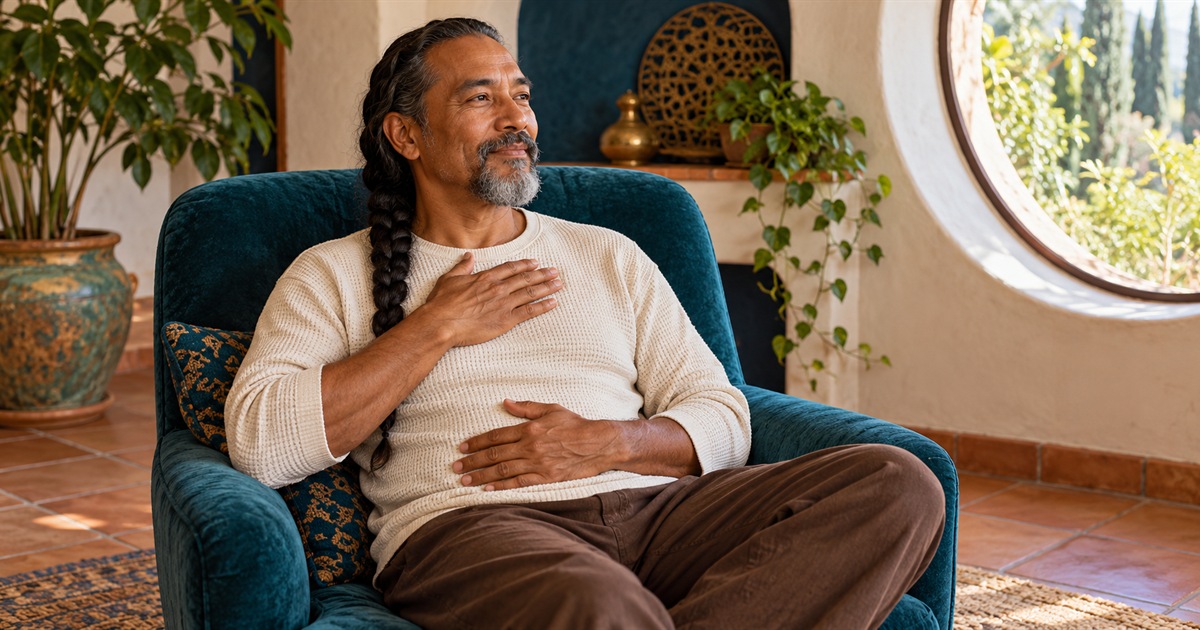
- PlaceRest your hands lightly on one area, such as your chest or belly. No pressure, no rubbing, no reaching for a sensation.
- StayBreathe normally and let your attention rest on the warmth of your hands or the room around you. Move to a second or third position if you like.
- CloseTake one ordinary breath, lower your hands, and return to your day. A short note about what happened is optional.
A step-by-step sequence for tonight
- Choose a modest goal. “A few quiet minutes” or “notice whether this feels comfortable” are goals you can meet. “Clear my blockage” is a test you can fail, and failing it tells you nothing.
- Set up the space. A chair with your feet supported, or your bed with a pillow under your knees, both work. Candles, crystals and music are optional.
- Start with your hands on your thighs. Let them rest there for a minute while your breathing settles. Adjust to your comfort, or rest your hands beside you instead. You can stay in one position or stop.
- Move to one or two other positions. Try the table below. Common choices are the upper chest, the belly, and the back of the head. Try a brief period in each if comfortable; there is no required duration.
- Let sensations come and go. You may notice warmth, boredom, drifting thoughts or nothing unusual. No sensation is required; do not dismiss pain, numbness or persistent tingling as part of the exercise.
- Finish on your own terms. Stop when the time is up or sooner. Ending early is not a failure.
- Record what actually happened. Duration, position, and whether it felt useful. Write “no difference” when that is honest.
Hand positions: comfort first
| Position | How to place your hands | Comfort tip | Skip or adjust if |
|---|---|---|---|
| Thighs | Palms down, resting loosely on your legs | A possible starting point; change position if uncomfortable | Pressure, leg discomfort, numbness or restricted movement |
| Upper chest | One or both hands flat below the collarbones | Let your elbows rest on cushions so your shoulders stay soft | Pain, healing wounds, dressings, a device site or clinician restrictions |
| Belly | Hands stacked or side by side below the ribs | Lying down makes this easier than sitting | Pregnancy discomfort, recent abdominal procedure, or nausea |
| Back of the head | Hands cupped behind the skull, fingers interlaced | Support your elbows or lie down to avoid arm fatigue | Neck or shoulder strain |
| Over the eyes | Palms hovering just above the eyes, not touching | Keep the hands light and never press on the eyes | Eyestrain, arm fatigue, recent eye treatment or clinician restrictions |
| Lower back | Hands flat on the back at waist level, or beside the body | Lie on your side if reaching behind is awkward | Wounds, rashes or areas that hurt to touch |
Two rules apply to every position. First, never press. Reiki as taught uses a light, still touch. Second, skip any area that is painful, injured, healing, or covered by a dressing or a medical device. Resting your hands beside your body is always an option, and a session with your hands on your thighs from start to finish is a complete session.
What sensations mean, and what they do not
Warmth can reflect ordinary skin contact; the cause of tingling or heaviness cannot be diagnosed from the exercise. Change position or stop if uncomfortable, and seek medical advice for new, persistent or concerning sensations. None of these is a sign that energy is moving, that a chakra is blocked, or that healing is happening. They are also not signs that you are doing it wrong. Our guide to mindful Reiki practice covers how to notice sensations without turning them into a story.
Emotions can surface during any quiet practice. If sadness or anxiety arrives, pause or stop, open your eyes and attend to the room or contact someone supportive. You do not need to continue. You do not need to decide that the feeling was “stored” under your hands, and you do not need to push through distress to make the practice count. A feeling that keeps returning or grows heavier over days is a reason to talk with someone you trust or a professional, not a task for the routine to solve.
Safety and boundary note. Self-Reiki is an optional comfort or spiritual practice, not a treatment. Do not use it to diagnose a symptom, replace prescribed care or delay a check-up, and avoid touching wounds, painful areas or medical devices. If low mood, anxiety or another emotional strain lasts for weeks or interferes with daily life, speak with a doctor or therapist. If you are in emotional distress or having thoughts of harming yourself, call or text 988 in the US to reach the 988 Suicide and Crisis Lifeline, or contact your local emergency number.
How self-Reiki compares with meditation and plain rest
It helps to know where the evidence is stronger. The NCCIH summary on meditation and mindfulness describes possible benefits for some symptoms, but also mixed findings, study limitations and possible negative experiences. Research on a structured mindfulness program cannot establish that this short hands-on routine has the same effects. Reiki has no comparable evidence base. From the outside, a self-Reiki session and a short body-scan meditation look almost identical: a person sitting still, breathing normally, paying gentle attention. If you prefer the attention without the hands, our article on using meditation to change your thinking is a natural next step. Plain rest, with no technique at all, is also a fair choice.
Fitting it into a week
There is no established schedule for this comfort exercise. If you find it useful, you might try brief sessions when convenient; more practice is not necessarily better. Many people pair it with something they already do, such as the minutes before sleep or the wait for the kettle. Keep the log from step seven for three or four weeks, then read it back. If the honest verdict is “pleasant but no real difference”, that is a fair outcome and a fair reason to keep going, change something, or stop.
- Do keep the goal small. Rest and quiet are enough.
- Do adapt positions to your body. Comfort beats any prescribed sequence.
- Do learn the basics if you want to go further. Our beginner’s guide to Reiki and our page on how to do Reiki explain the traditional hand positions and terms.
- Avoid pressing or rubbing. The touch is light and still, or hovering.
- Avoid treating sensations as diagnoses. Warmth is warmth; it is not a reading of your organs or chakras.
- Avoid using the routine to postpone care. New pain, a change in a symptom or persistent low mood needs a clinician first.
When a different kind of help is needed
A comfort routine has a small job. It is the wrong tool for pain that is new or getting worse, sleep problems that last weeks, symptoms you cannot explain, and depression or anxiety that interferes with work or relationships. Those belong with a doctor, a therapist or both, and self-Reiki can continue alongside that care as a pleasant habit. Our review of seven common Reiki claims explains how to spot when a routine is being oversold, and our guide to Reiki safety and boundaries with medical care covers what to keep in place.
Key Takeaways
- Traditional self-Reiki and an untrained quiet-rest exercise are not identical; neither requires accepting an unproven energy mechanism.
- NCCIH says Reiki has not been clearly shown effective for health purposes. Its safety summary is not a guarantee that every position or quiet practice suits everyone.
- Comfort decides hand position; thighs, chest, belly and the back of the head are common, and pressing is never part of it.
- Sensations do not establish energy flow or healing. Do not dismiss new or persistent symptoms as a spiritual response.
- Persistent pain, sleep trouble or low mood belongs with a clinician, with the routine continuing alongside care if you enjoy it.
Related reading
- How to Do Reiki
- Beginner Reiki Healing
- Mindful Reiki Healing
- Reiki Research: What the Evidence Can and Cannot Show
- Reiki Safety, Risks and Boundaries with Medical Care
- Using Meditation to Change Your Thinking
Frequently Asked Questions
1. Do I need Reiki training to practise self-Reiki?
Quiet rest with comfortable hand positions needs no Reiki training. Traditional self-Reiki is taught within Reiki courses; this exercise does not confer training or practitioner status.
2. Is self-Reiki proven to heal anything?
No. NCCIH says Reiki has not been clearly shown effective for any health-related purpose. Some people may still value it as an optional comfort or spiritual practice.
3. How long should a self-Reiki session last?
There is no proven required duration for this comfort exercise. Start briefly if you wish, adapt to comfort and stop at any time.
4. Where should I put my hands?
Choose comfortable positions or no touch. Skip painful, injured or healing areas, dressings and device sites, and follow any medical positioning restrictions.
5. Should I press or massage?
No pressure or massage is needed. Use light still contact, hovering or hands resting beside you, and avoid uncomfortable areas.
6. Why do my hands feel warm during self-Reiki?
Ordinary skin contact can produce warmth. A feeling of warmth does not establish energy flow or healing, and concerning symptoms need appropriate medical advice.
7. I feel nothing at all. Am I doing it wrong?
No. You do not need a special sensation, and no change is an acceptable observation. Stop or choose another activity if the exercise does not suit you.
8. Can I do self-Reiki lying in bed?
You may choose a comfortable supported position, including lying down if appropriate for you. Follow any clinician restrictions and avoid positions that require strain.
9. Is self-Reiki the same as meditation?
No. They may overlap in quiet attention, but traditions and methods differ. Evidence for particular mindfulness programs does not establish effects for self-Reiki.
10. Is self-Reiki safe during pregnancy or after surgery?
Do not assume every position is appropriate. Follow your treating clinician’s advice after surgery or during pregnancy, avoid pressure on wounds or devices, and ask about restrictions if uncertain.
11. What if I feel sad or anxious during a session?
Pause or stop, open your eyes and orient to your surroundings. Seek support if distress persists or interferes with life; you do not have to push through it.
12. Can self-Reiki replace my medication or therapy?
No. Keep prescribed care in place unless your treating clinician advises a change. An optional comfort routine must not delay assessment or treatment.
13. Do I need candles, crystals or music?
No equipment is needed. If you use music or other items, keep the setting comfortable and avoid unnecessary purchases or unsafe candles.
14. How do I know whether self-Reiki is working for me?
Record whether it felt comfortable or useful, including no change. A log can help you decide whether to continue, but cannot prove healing or establish the cause of a health change.
Final thoughts
A self-Reiki routine asks very little of you: a chair, a few minutes and hands that rest rather than work. Keep your goals modest, your touch light and your medical care where it is, and let the routine be what it is: a quiet pause that belongs to you.
“Deep Relaxation and Stress Reduction”—Sure, because touching my own forehead is going to magically reduce my stress levels. Why didn’t I think of this sooner?
This article provides a comprehensive overview of self-healing Reiki. It’s fascinating how such an ancient practice can have profound modern-day applications. Truly enlightening!
“Empowerment and Self-Care”—because clearly, all you need in life is to place your hands on yourself and voilà, problems solved! No need for doctors anymore!
For those new to Reiki, this guide is extremely helpful. The step-by-step approach makes it accessible for anyone looking to start their self-healing journey.
While the benefits of self-healing Reiki are highlighted, there’s a lack of empirical evidence supporting these claims. How do we differentiate between placebo effects and genuine healing?
I find it hard to believe that placing your hands on different parts of your body can actually heal anything. Sounds like pseudoscience to me.
“Spiritual Growth and Connection”—Ah yes, because nothing says spiritual enlightenment like playing a game of ‘Simon Says’ with your chakras.
Hey now, don’t knock it till you’ve tried it! Sometimes the simplest methods bring the most profound results.
I got a good laugh out of this comment! But seriously, sometimes humor helps us look at things from a different perspective.
The practical tips provided here for practicing self-healing Reiki are very useful. Even if one remains skeptical about its effectiveness, trying it out with an open mind could be quite beneficial.