

Quick Guide
Reiki and yoga can share a routine without being the same practice. Yoga may involve movement, breathing and meditation; self-Reiki uses light touch or hands held nearby within a spiritual tradition. The optional twenty-five-minute plan below puts comfortable movement before rest. Shorten or adapt it to your needs. Neither the pairing nor its timing guarantees relaxation, increased energy or a medical benefit.
Choose this combination if you enjoy both activities, not because one has been shown to amplify the other. Research on yoga and research on Reiki should be considered separately. A satisfying personal practice is different from an established treatment or evidence of a special combined effect.
What each practice adds
| Comparison | Yoga | Reiki self-practice |
|---|---|---|
| What it is | Postures, breathing and meditation; styles vary | Light touch or hands held nearby, understood through Reiki tradition |
| What someone may experience | Movement, body awareness or a sense of settling | A quiet pause; experiences differ |
| Evidence | The NCCIH yoga overview describes possible benefits, with evidence varying by outcome and practice | The NCCIH Reiki overview says health effectiveness is not clearly established and the proposed energy field lacks scientific support |
| Risks | Injury is possible; poses and breathing may need modification | Choose comfortable positions and touch; do not delay care |
| Place in this routine | Optional comfortable movement | Optional quiet self-practice or ordinary rest |
Movement first is one possible order, not a requirement. Some people prefer resting first or keeping the practices separate. This plan is a flexible scheduling example, not a tested treatment protocol.
A combined routine, twenty-five minutes
- Two minutes to arrive. Sit or stand comfortably with support if needed. Notice your ordinary breathing without forcing a slower pace or holding your breath.
- Ten minutes of familiar, comfortable yoga. Use movements you have learned with a qualified instructor and adaptations suited to you. If sun salutations are appropriate for you, use a familiar adapted version; there is no required number of rounds or one-breath-per-pose rule. Beginners need instruction rather than a written list of demanding poses. Skip movement when unsuitable and use a comfortable seated pause instead.
- Three minutes to pause. Choose a supported position that feels comfortable. Sitting is an option; child’s pose and lying flat are not suitable for everyone.
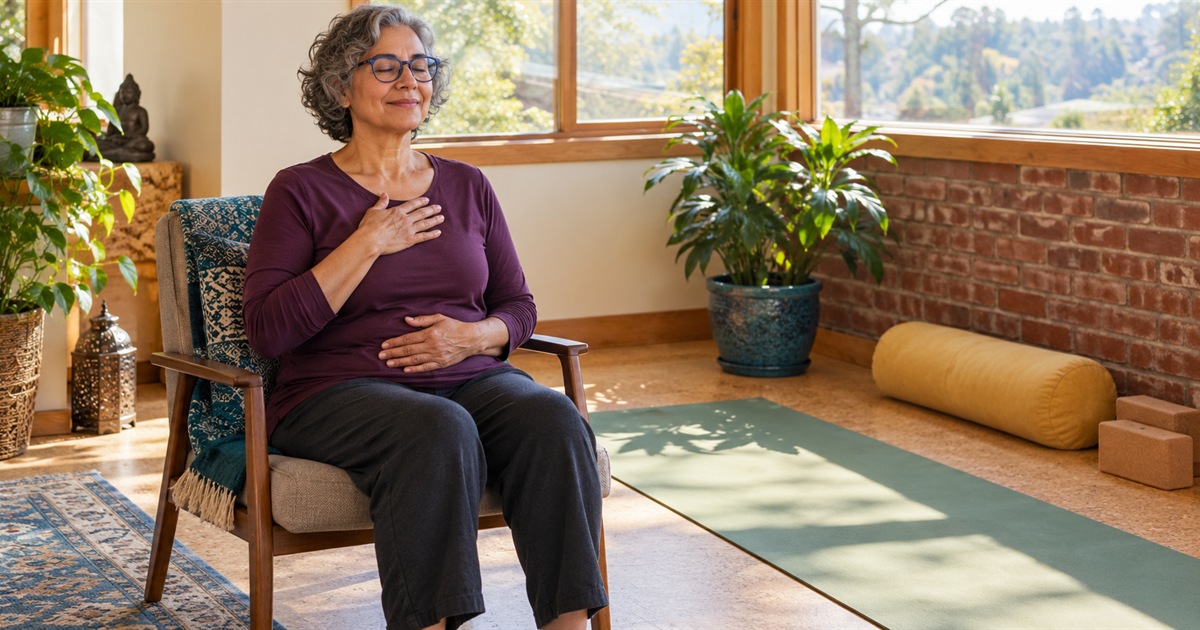
- Nine minutes of optional self-Reiki or rest. Rest your hands lightly where comfortable, such as on your thighs, or hold them nearby. Avoid pressure on your eyes or throat, and keep breathing normally. Divide the time as you wish; no fixed hand sequence is necessary for an ordinary quiet pause. The self-practice guide explains the distinction between Reiki training and simple rest.
- One minute to finish. Release your hands and change position slowly when ready. These five stages total twenty-five minutes; transitions are included. Take longer or stop sooner if needed.
Choose a frequency that fits your interest and comfort. There is no established dose for this combined routine, and daily practice is not necessary. Notice how you feel without treating an immediate sensation as evidence that a condition has improved.
Why someone might pair them
Someone who enjoys moving before resting may find the sequence convenient. Another person may prefer quiet time without exercise. Neither preference proves an energy mechanism or special synergy. If you choose a breathing-based Reiki practice instead, keep it comfortable and avoid forceful breathing; the Japanese Reiki techniques guide describes traditional approaches and their limits.
Claims to leave behind
- “Yoga increases the flow of Reiki energy.” Spiritual interpretations are not evidence of a measurable increase or enhanced healing.
- “Yoga cures arthritis, asthma or heart problems.” Adapted yoga may have a role alongside care, including symptom support for some conditions. It is not a cure or a reason to stop treatment.
- “Yoga eliminates alcohol, tobacco and drug addictions.” Some research considers yoga as an addition to treatment, not a guaranteed cure. Seek appropriate professional support; Reiki does not replace it.
- “Postures open the inner channels of energy.” Energy-channel language belongs to spiritual traditions, not an established physical mechanism.
- “The pairing brings ultimate transformation.” No outcome is assured. Enjoyment or a quiet pause is a personal experience, not a promise everyone will share.
Safety, briefly. Yoga can cause injury. Learn with a qualified instructor, avoid pushing through pain and use suitable adaptations. Discuss individual needs with a health professional and instructor if you are pregnant, older, injured or managing a health condition. Pregnancy can require avoiding prolonged lying flat on the back; sitting or other supported positions may be more appropriate. Stop if you feel pain, dizziness or distress. Neither a restful position nor light touch is automatically comfortable for everyone. Do not use this routine to postpone medical care or change medication.
Key Takeaways
- Pair the practices only if the combination suits you; movement before rest is optional.
- Evidence for yoga varies by outcome; Reiki health effectiveness is not clearly established.
- The flexible plan totals twenty-five minutes, including its closing minute.
- Neither energy amplification nor a cure is established by combining them.
- Adapt movement, breathing and resting positions; continue appropriate care.
Related reading
- How to do Reiki: self-practice, training and limits
- Gassho and joshin kokyu ho, step by step
- Mind-body approaches in therapy: evidence and safety
- Chakra work with Reiki: a 20-minute body scan
- How does Reiki work? Tradition vs evidence
Frequently Asked Questions
1. Can you combine Reiki and yoga?
You can choose to combine them if both suit you. The example pairs optional familiar yoga with quiet self-practice or rest; a special combined benefit has not been established.
2. Which should come first?
This example puts yoga first, then a pause and rest. That order is optional; choose what feels comfortable or keep the practices separate.
3. Does yoga increase Reiki energy?
There is no scientific basis for claiming that yoga increases Reiki energy or amplifies its healing effects. Energy language can be a spiritual interpretation.
4. What does the evidence say about yoga?
Yoga may support aspects of wellbeing or symptom management, but evidence varies by outcome, style and study quality. Findings about yoga alone do not establish a benefit from adding Reiki.
5. What does the evidence say about Reiki?
Reiki has not been clearly shown to be effective for health-related purposes, and its proposed energy field lacks scientific support. Feeling relaxed is not proof of medical effectiveness.
6. Can yoga treat arthritis, asthma or heart disease?
Adapted yoga may support some symptoms alongside care, but it is not a cure or a substitute for treatment. Ask your health professional and instructor about appropriate modifications.
7. Can yoga cure addiction?
No guaranteed cure is established. Some research considers yoga as an addition to substance-use treatment or smoking-cessation support. Appropriate professional care remains important.
8. How long should the combined routine take?
The example totals twenty-five minutes: two to arrive, ten for optional familiar yoga, three to pause, nine for self-practice or rest and one to finish. Shorten or adapt it as needed.
9. How often should I practise?
There is no established frequency for this combined routine. Choose a manageable schedule based on comfort and interest without expecting a guaranteed benefit.
10. Do I need a Reiki attunement for the self-Reiki part?
Ordinary rest with comfortable light touch does not require a ceremony. Reiki schools may require attunement for what they teach as Reiki practice; this quiet pause does not claim to confer training or healing ability.
11. What is the sun salutation?
It is a family of linked yoga movements with different versions. It can include standing, folds and supported floor movements. Learn an appropriate version with an instructor rather than treating a written sequence as suitable for everyone.
12. Is yoga safe?
Injuries can occur. Qualified instruction and individual adaptations matter, especially with pregnancy, older age, injury or a health condition. Stop painful or distressing practice and seek appropriate advice.
13. Can I replace the yoga part with breathing?
You can replace movement with a comfortable quiet pause and ordinary breathing. Forceful or prolonged breathing techniques are not required and may be unsuitable for some people.
14. Do postures open energy channels?
Energy-channel language belongs to spiritual traditions, not an established physical mechanism. Postures do not demonstrate that an energy channel has opened.
15. What is the honest promise of Reiki and yoga together?
No result can be promised. It is an optional way to schedule movement and rest, not a proven combined treatment or guarantee of relaxation, improved health or transformation.
Final thoughts
Build a routine around what you can comfortably do, not a promised result. Familiar movement, supported rest and the freedom to stop are enough to make this a personal choice. Keep spiritual meaning separate from medical claims, and let appropriate care guide health decisions.
The detailed explanation of Hatha Yoga and its techniques offers valuable insights into the practice.
Yes, understanding the postures and breaths in depth can significantly enhance the practice.
The flexibility in the frequency and duration of yoga practice, as mentioned, makes it accessible for various lifestyles.
The mention of Vigh Bela’s study on the effects of yoga exercises on the nervous system is particularly noteworthy.
The scientific validation of yoga’s impact on the nervous system is an intriguing point that adds credibility to traditional practices.
It’s fascinating how the Sun Salutation is described as a summary of Hatha Yoga postures, emphasizing its foundational importance.
The integration of Yoga and Reiki practices seems to offer a comprehensive approach to both physical and emotional well-being.
Indeed, combining these disciplines might provide a more holistic understanding of oneself.