
Quick Guide
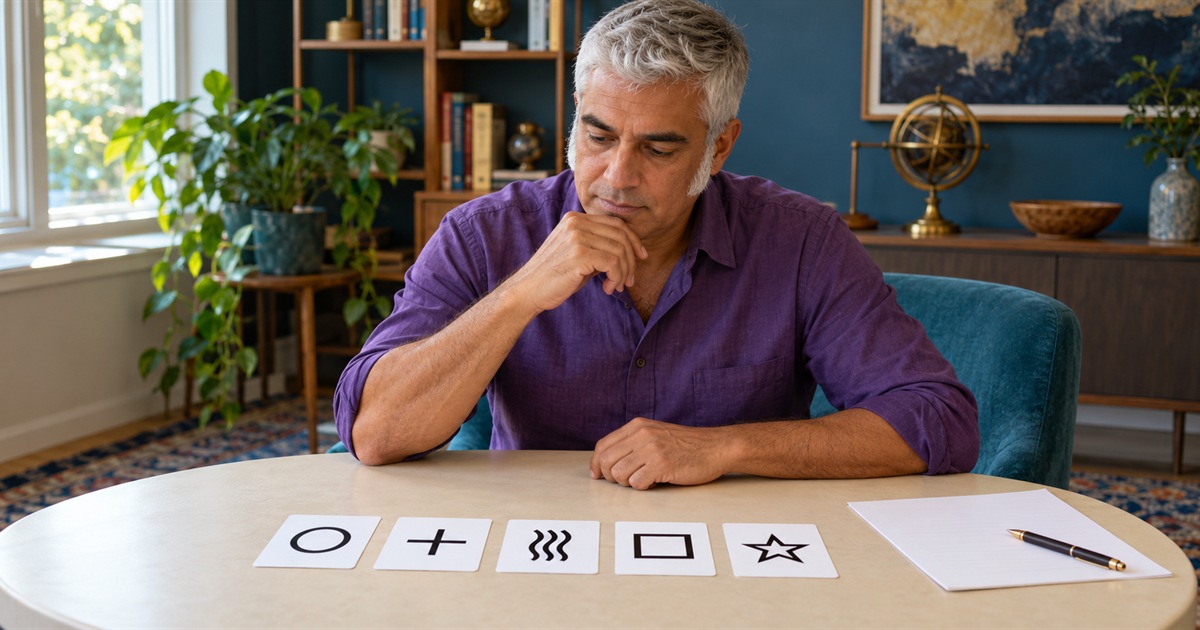
Zener cards use five simple symbols to explore card guessing: a circle, cross, wavy lines, square and star. A traditional deck has five of each. If a target is selected independently and each symbol is equally likely on every trial, a guess made without target information has a one-in-five chance of matching. This guide explains that model, a careful home exercise and the limits of what a score can tell you. A game at home is not a definitive test of paranormal ability.
The useful part is the record: decide what you will do before starting, write down every guess, and keep misses as well as hits. An impression that feels strong can still be wrong; an unexpectedly high score can have more than one explanation.
Where Zener cards come from
The cards are named for psychologist Karl Zener and associated with J. B. Rhine’s research at Duke University in the 1930s. Duke’s archive describes the laboratory’s card-guessing experiments and displays a historical deck in its Zener cards exhibit. That history explains their use, but the age or familiarity of a tool does not establish paranormal claims.
What chance looks like
The selection rule matters. The figures below assume independent trials, with each of the five symbols equally likely every time. With cards, return the selected card to the full deck and randomize again before each trial. Drawing all 25 cards without replacement is a different design: the remaining composition changes, so the same probability calculation cannot automatically be applied.
| Planned trials | Expected matches | Standard deviation |
|---|---|---|
| 25 | 5 | 2 |
| 100 | 20 | 4 |
| 500 | 100 | About 8.94 |
Expected matches are an average over many repetitions, not a promised score. Standard deviation describes the spread of totals; it is not a pass/fail threshold. These figures follow the binomial model described by NIST, with match probability 0.2.
Under that model, a preplanned run of 25 trials has about a 10.91-per-cent chance of eight or more matches and a 4.68-per-cent chance of nine or more. Those are probabilities of results under the model, not probabilities that a person has psychic ability. Repeating many runs and reporting only the best makes an impressive-looking total much easier to obtain.
How to run the test honestly
- Agree on the plan. Choose the number of trials, the five permitted guesses, the scoring rule and any exclusions before starting. Do not extend a run to chase a better score or stop when it looks impressive.
- Prepare indistinguishable cards. Use a full deck of 25 opaque cards with identical backs, five of each symbol. Check for markings, transparency and reflections. A suitable random-selection tool is another option, but its output must remain hidden from the guesser.
- Select independently each time. Randomly draw from the full deck, record the target, return the card and mix again before the next trial. There is no universal shuffle count that guarantees randomness. Predictable or biased selection undermines the comparison.
- Prevent target information reaching the guesser. Separate rooms can reduce visual cues; also consider sounds, timing and messages. A tabletop screen or off-camera card alone is not proof that leakage has been eliminated.
- Record before feedback. Keep separately numbered target and guess records. The guesser must commit a symbol before learning whether it matched. Compare the records only after the planned run ends.
- Report the complete result. Count exact matches and retain every planned trial and run, including misses. Describe errors and departures from the plan. Do not substitute a favourite streak for the whole result.
- Treat follow-up as a new test. If you compare roles, methods or sender conditions, define those comparisons beforehand. Keep their results separate. An independently designed replication is stronger than repeating the same imperfect setup.
The four “clair” exercises, kept as a game
Some spiritual practices describe impressions as pictures, words, feelings or sudden knowing. These correspond to terms discussed in intuition and the four clairs. You may use those labels to describe your experience, but they do not establish a paranormal source. Different observed scores can arise through chance, different procedures or ordinary information cues; equal scores should not simply be assumed.
Decide what counts before playing. Only an exact recorded symbol match counts as a hit in this exercise. A feeling of being “close”, remembering a successful streak, or interpreting every outcome as progress cannot replace the scoring rule. Participation is optional; stop if the exercise becomes distressing or compulsive.
What the honest result tells you
- A result near the expected score does not show a clear departure from this chance model. It is not a verdict on your whole personality, beliefs or everyday judgement. It also does not validate hunches about hidden targets.
- An unusually high result calls for checking selection, leakage, recording and the number of comparisons made. It does not identify the cause. Preserve the complete record before attempting an independent replication.
- Sender comparisons need the same planned scoring and safeguards in each condition. Similar scores cannot, by themselves, prove that nothing was transmitted; differing scores cannot, by themselves, establish telepathy.
Relaxation or a spiritual practice can be meaningful without proving card-guessing accuracy. The distinction also matters when considering whether Reiki enhances psychic abilities. Do not use this exercise to make health, financial or relationship decisions.
Key Takeaways
- The traditional deck has 25 cards and five symbols.
- The one-in-five independent model requires an equally likely target selected afresh on every trial.
- Plan the trial count and scoring first, record before feedback and retain all results.
- A surprising score is not a paranormal diagnosis; controls, complete reporting and independent replication matter.
- A home exercise can teach careful observation without settling broader claims about psychic ability.
Related reading
- Intuition and the four clairs: what they are and how to develop them honestly
- Does Reiki enhance psychic abilities? What really sharpens
- Is Reiki channelled energy? What attention actually does
- What does research say about Reiki?
- Facts about Reiki: 20 statements checked
Frequently Asked Questions
1. What are Zener cards?
A traditional Zener deck has 25 cards: five each of a circle, cross, wavy lines, square and star. The symbols were used in historical extrasensory-perception experiments.
2. Who invented Zener cards?
The cards are named for psychologist Karl Zener and associated with J. B. Rhine’s card-guessing research at Duke University in the 1930s.
3. What is the chance score on a Zener run?
With independent, equally likely targets selected afresh on every trial, the chance match probability is 20 per cent and the expected total over 25 trials is five. Actual totals vary; five is an average, not a required result.
4. Did Rhine’s experiments prove ESP?
A historical report of above-chance guesses is not, by itself, proof of ESP. Evaluating a claim requires the original methods, safeguards, complete data and independent replication; this home exercise cannot settle that question.
5. Can Zener cards develop psychic ability?
There is no basis here for promising that practising with cards develops paranormal ability. They can be used as a guessing game and a lesson in recording results and comparing them with a stated chance model.
6. How do I run the test properly?
Agree on the number of trials and scoring rules first. Randomly select a target with replacement on every trial, prevent access to the target, record guesses before feedback, retain every trial and report the full planned result.
7. Can I do it over a video call?
A video call can support a casual game, but hiding the card and face does not guarantee adequate controls. Reflections, sounds, timing, shared screens and recording mistakes can still affect results.
8. What is a no-sender run and why does it matter?
In a no-sender condition, nobody observes the target before the guess. Comparing predefined sender and no-sender conditions may be informative, but similar scores do not prove that nothing was transmitted.
9. I scored nine out of 25. Am I psychic?
No single score establishes psychic ability. Under the independent 20-per-cent model, nine or more matches in 25 trials occurs about 4.68 per cent of the time by chance. That is not the probability that you are psychic, and selecting your best run changes the interpretation.
10. What are the four clairs?
Clairvoyance, clairaudience, clairsentience and claircognizance are spiritual terms for impressions described as seeing, hearing, feeling and knowing. The labels do not establish how an impression arose or guarantee equal observed scores.
11. Should I keep score during the run?
Record each guess and target in separate numbered records, but withhold match feedback until the planned run ends. Include misses, errors and all runs; apply any exclusion rule agreed beforehand.
12. Do essential oils or intentions help?
Neither is required for this exercise, and neither should be presented as a proven way to improve card-guessing accuracy. A personal intention may guide participation, but it is not a substitute for controls and honest scoring.
13. What if I score high consistently?
Preserve the full records, check for ordinary information leakage and scoring errors, and seek an independently designed replication. An unusual score is a reason to investigate, not proof of a paranormal explanation.
14. What does scoring at chance tell me?
It means this recorded result does not show a clear departure from the stated chance model. It neither validates impressions about hidden targets nor determines every aspect of your intuition or personal beliefs.
15. Can I make my own Zener deck?
Yes. Use identical opaque cards with five of each symbol, and check for markings or visible symbols through the backs. For the independent model in this guide, replace the selected card and mix the full deck before every trial.
Final thoughts
Let the complete record guide your interpretation, not the most memorable guess. The value of this exercise is learning how predictions, chance and safeguards fit together. You can enjoy the game while remaining honest about what it does and does not establish.
It’s important to keep in mind that these exercises are primarily for fun and personal development rather than definitive proof of psychic abilities.
The activities seem to be designed for fun more than scientific rigor, but they might foster a better connection among participants.
Using Zener cards to develop psychic abilities sounds like an interesting and structured approach. I’m curious about how effective these exercises can be over time.
The inclusion of essential oils is a nice touch, though it seems more of a preference rather than a necessity for these exercises.
Yes, essential oils might help some people relax or concentrate better, but they are certainly optional.
I agree, essential oils can enhance the experience, but each person may have different preferences.
The specificity of the exercises, from clairvoyance to claircognizance, is quite detailed. It’s good to see a methodical approach to what is often considered a vague subject.
Having a partner to practice with, whether physically present or via video, adds a social element that could make the exercises more engaging.