Quick Guide
The seven-chakra system is a map of the body used in yoga, Reiki and much modern wellness writing: seven points from the base of the spine to the crown, each linked to a colour, a set of feelings and, in crystal practice, a stone. Used as a reflection tool it is pleasant and sometimes useful. Used as a diagnosis, “your throat chakra is blocked”, or as a treatment, “place carnelian on your sacral chakra to heal it”, it is neither. This guide gives the map, its real history, the traditional stone pairings, how to use them without expecting them to do anything, and the claims to leave behind.
The version of this page that used to sit here told readers that chakras can be “clogged with negative energy”, that trauma is “stored” in them and must be “deeply felt” to be released, and that shungite protects the body from radiation. None of that is supported and some of it is unwise. The chakra map, on the other hand, is a perfectly good thing to know about, and so is the honest way to use a handful of stones.
Where the chakra system actually comes from
Chakra means “wheel” in Sanskrit, and chakra systems appear in Indian tantric texts from roughly the eighth century onwards, not in the Vedas as often claimed. Those texts describe several different systems with four, five, six, seven or more centres, used as visualisation maps for meditation rather than as anatomy. The seven-chakra version familiar today, with its rainbow of colours and its list of psychological themes, took shape in the West in the twentieth century, drawing on a 1919 translation of a sixteenth-century text and on later Theosophical and New Age authors. That does not make it worthless; it makes it a modern meditation framework with old roots, which is what it should be treated as.
The seven chakras and their traditional pairings
| Chakra | Location | Traditional themes | Colour | Stones commonly paired |
|---|---|---|---|---|
| Root | Base of spine | Safety, stability, the basics of survival | Red | Black tourmaline, red jasper, smoky quartz |
| Sacral | Lower abdomen | Pleasure, creativity, relationships | Orange | Carnelian, orange calcite |
| Solar plexus | Upper abdomen | Confidence, will, personal power | Yellow | Citrine, tiger’s eye |
| Heart | Centre of chest | Love, compassion, grief | Green (sometimes pink) | Rose quartz, green aventurine |
| Throat | Throat | Expression, honesty, being heard | Blue | Lapis lazuli, sodalite, angelite |
| Third eye | Between the brows | Insight, imagination, clear thinking | Indigo | Amethyst, sodalite |
| Crown | Top of the head | Meaning, connection, perspective | Violet or white | Clear quartz, selenite |
The themes are the useful part. They give you seven prompts for checking in with yourself: do I feel safe, am I enjoying anything, do I feel capable, am I connected to people, am I saying what I mean, am I thinking clearly, does anything feel meaningful. Signs your chakras are blocked works through those prompts as a reflection exercise and is clear about which physical or emotional signs need a clinician instead.
What crystals can and cannot do
The evidence on crystals is short. Controlled tests in which people meditated holding either a real quartz crystal or a glass fake found that both groups reported the same warm, tingling, calming sensations; expectation did the work, and the stone did not. No study has found a mineral held or worn on the body to have an effect on any physical or emotional condition. Nor is there a mechanism: quartz’s piezoelectric property, sometimes cited, requires mechanical stress and produces a current far too small to affect tissue.
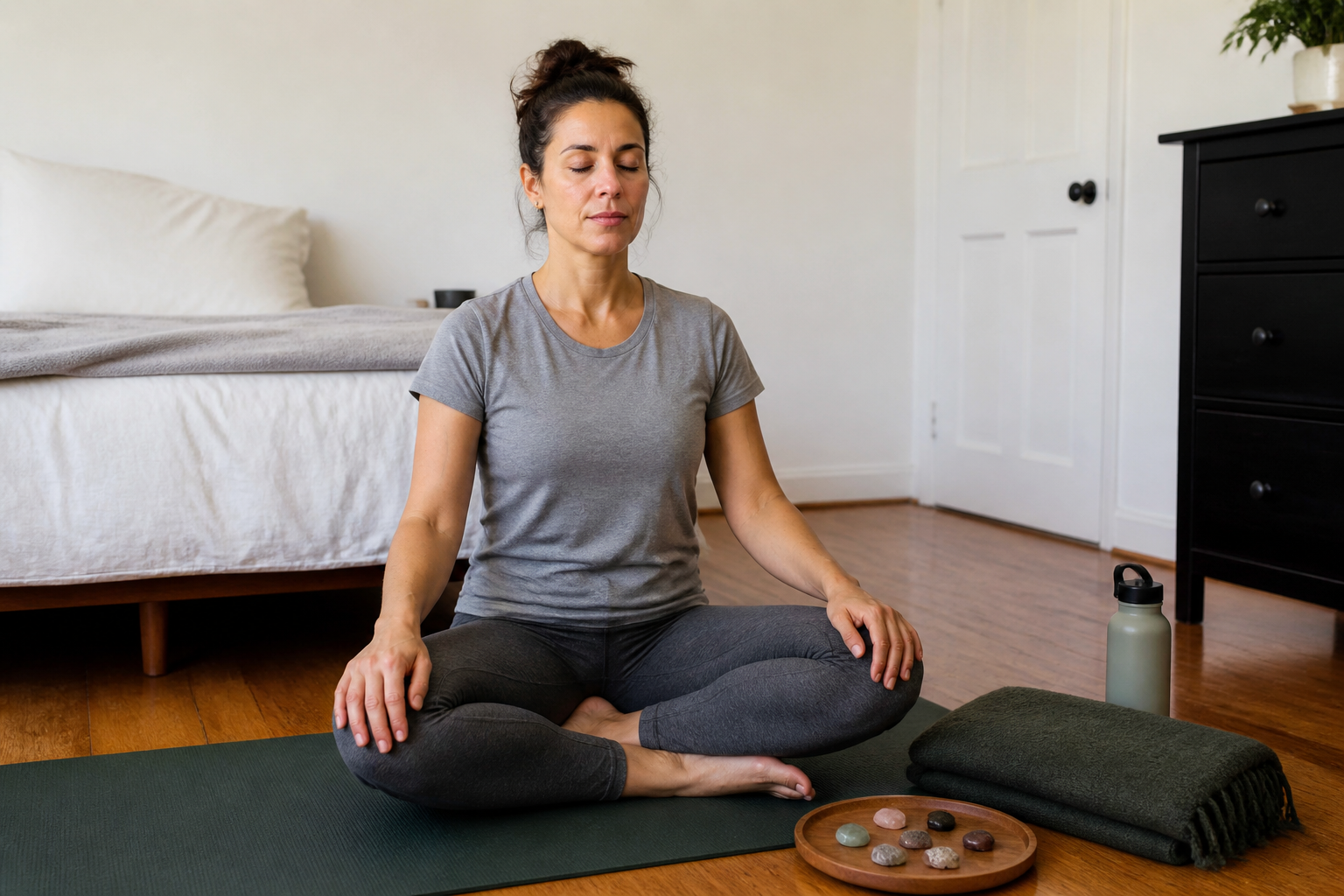
What crystals reliably do is act as objects for attention. Holding a smooth stone while you breathe gives the hands something to do and the mind something to rest on. Placing one on the body during a lying-down practice gives you a physical marker for the area you are attending to. Keeping one in a pocket can serve as a reminder of an intention you set. Those are real uses, and they cost nothing in honesty as long as you do not tell yourself or anyone else that the stone is doing something.
Two safety notes. First, do not make “crystal elixirs” by soaking stones in drinking water: several popular minerals, including malachite, some forms of selenite and anything containing copper, lead or arsenic compounds, are unsafe to ingest. Second, the claim that shungite “protects from radiation” is false and can lead people to skip real precautions. Keep stones on the outside of the body and treat every health claim printed on a crystal-shop label as decoration.
A chakra and crystal practice that stays honest
- Lie down somewhere warm and quiet. Ten to twenty minutes. A blanket and an eye mask help.
- Place a stone, or just a hand, at each of the seven points in turn, starting at the base of the spine and moving up. Stay two minutes at each.
- At each point, ask the theme question. “Do I feel safe at the moment?” “Am I saying what I mean?” Notice the honest answer without arguing with it.
- Breathe slowly through the nose and let the belly rise and fall. This is the part that produces the calm.
- Afterwards, write down anything that came up. If a theme keeps returning over several sessions, that is worth thinking about, talking about or, if it is heavy, taking to a therapist.
Reiki self-practice uses a similar sequence of positions, and many practitioners combine the two; how to do Reiki gives the hand positions, and chakra work with Reiki shows how the map is used inside a session.
Claims to leave behind
- “Chakras get clogged with negative energy.” There is nothing to clog. If you feel heavy or stuck, the chakra map can help you name which area of life it belongs to; it does not explain it.
- “Trauma is stored in the chakras and must be deeply felt to release it.” Trauma is stored in memory and the nervous system, and processing it is skilled work. Deliberately “feeling each emotion deeply” alone on a yoga mat can retraumatise rather than release. If a practice brings up something heavy, stop and find a trauma-informed therapist.
- “Eat the rainbow to feed each chakra.” Eating a variety of colourful vegetables is good advice for entirely ordinary reasons; the colours do not correspond to anything in the body.
- “Smudging clears the auric field.” Burning sage smells nice and marks a moment; it clears nothing, and burning it indoors regularly is a respiratory irritant.
- “Zip up your chakras for protection.” A visualisation that some people find comforting. It protects against nothing, because there is nothing to protect against.
Where the map is genuinely useful
Used lightly, the chakra system is a good structure for the kind of check-in most people never do. Seven questions, asked once a week, covering safety, pleasure, confidence, connection, honesty, clarity and meaning, will surface things a to-do list never will. The colours and stones make the questions memorable and the practice pleasant. Keep all of that. Drop the idea that any of it is happening inside your body, and the practice becomes both honest and durable. The Reiki safety guide explains why that distinction matters most for people who are unwell.
Key Takeaways
- The seven-chakra system is a modern meditation map with medieval tantric roots, not Vedic anatomy.
- Its seven themes make useful weekly check-in questions; its colours and stones make them memorable.
- Crystals produce the same sensations as glass fakes; they are attention objects, not treatments.
- Never ingest crystal water; ignore radiation and health claims on labels.
- Trauma is not stored in chakras and should be processed with a therapist, not alone on a mat.
Related reading
- Signs your chakras are blocked: a reflective guide, not a diagnosis
- How to do Reiki: self-practice, training and limits
- Chakra work with Reiki
- Mind-body approaches in therapy: evidence and safety
- How does Reiki work? Tradition vs evidence
Frequently Asked Questions
1. What are the seven chakras?
Seven points on a meditation map running from the base of the spine to the crown: root, sacral, solar plexus, heart, throat, third eye and crown, each with a colour and a set of themes.
2. Where does the chakra system come from?
Indian tantric texts from about the eighth century onwards described several systems. The seven-chakra rainbow version took shape in the West in the twentieth century.
3. Are chakras real?
They are real as a map for meditation and reflection. They are not anatomical structures and have not been detected by any measurement.
4. Can chakras be blocked?
Not physically. The word is a way of saying an area of life feels stuck; the map helps you name it, not diagnose it.
5. Do healing crystals work?
Tests show people feel the same sensations holding a real crystal or a glass fake. Crystals are useful objects for attention; they do not treat anything.
6. Which crystal goes with which chakra?
Traditionally: root with black tourmaline or red jasper, sacral with carnelian, solar plexus with citrine or tiger’s eye, heart with rose quartz, throat with lapis or sodalite, third eye with amethyst, crown with clear quartz or selenite. The pairings are by colour, not effect.
7. Is it safe to drink crystal-infused water?
No. Several common minerals leach toxic compounds. Keep stones out of drinking water.
8. Does shungite protect from radiation?
No. The claim is false and can lead people to skip real precautions.
9. How do I balance my chakras?
Lie down, attend to each of the seven points for two minutes with slow breathing, ask each theme question, and write down what comes up. The calm comes from the rest and the breath.
10. Is trauma stored in the chakras?
No. Trauma is held in memory and the nervous system. Processing it is skilled work for a trauma-informed therapist, not something to force alone on a mat.
11. Does eating foods of each colour feed the chakras?
Eating a variety of colourful vegetables is good for ordinary nutritional reasons. The colours do not correspond to anything in the body.
12. Does smudging with sage clear energy?
It marks a moment and smells pleasant. It clears nothing, and regular indoor burning irritates the lungs.
13. Can chakra work replace therapy or medical care?
No. It is a reflection practice. Persistent physical symptoms or heavy emotional material need a clinician.
14. How does the chakra map fit with Reiki?
Reiki hand positions roughly follow the seven points, and many practitioners use the themes to structure a self-practice. The map is a framework, not a mechanism.
15. What is the most useful thing about the chakra system?
Seven memorable questions, about safety, pleasure, confidence, connection, honesty, clarity and meaning, that make a weekly check-in easy to do.
Final thoughts
The seven chakras and their stones make a good weekly practice for one reason: they give you seven honest questions and a pleasant way to sit with them. Everything beyond that, the clogging, the storing, the protecting, the radiation, is decoration at best and a hazard at worst. Keep the map, keep the stones if you like them, ask the questions, and take anything heavy that comes up to someone trained to help with it.
Statements about crystal research and mineral safety reviewed on 26 September 2026.