
Quick Guide
Reiki is a Japanese relaxation practice from the 1920s in which a practitioner rests their hands on or just above a fully clothed person. The tradition explains it as channelling a life energy; research has not found that energy or shown that Reiki treats any condition. What people reliably get is a calm, attentive session. This guide covers the history, the five precepts, how a session runs, how Reiki differs from similar practices, and how to hold the tradition and the evidence side by side.
Most explanations of Reiki either sell it or dismiss it. Neither is much use if you are simply trying to understand what it is before you book a session, take a class, or talk to a friend who swears by it. This is the plain version: what the tradition says, what actually happens in the room, and what can honestly be claimed.
Where Reiki came from
Reiki was developed in Japan by Mikao Usui, a lay Buddhist practitioner, in the early 1920s. According to the tradition, he formulated the practice after a period of fasting and meditation on Mount Kurama near Kyoto, then opened a clinic in Tokyo and began teaching. The word combines rei (spirit or universal) and ki (life energy), a concept shared with Chinese qi and Indian prana.
How Reiki reached the West
- 1922: Usui founds his method and society in Tokyo and begins teaching students, including naval officer Chujiro Hayashi.
- 1926: Usui dies. Hayashi continues, opening a clinic and developing a more structured system of hand positions.
- 1935 to 1938: Hawayo Takata, a Japanese-American from Hawaii, is treated at Hayashi’s clinic, trains with him and is initiated as a master in 1938.
- 1938 to 1980: Takata practises and teaches in Hawaii and the mainland United States, training twenty-two masters before her death.
- 1980s onward: Those masters spread Reiki across North America and Europe, producing the many lineages and styles that exist today.
Dates follow the account given in most Reiki lineages. Records from the early Japanese period are sparse, and details vary between schools.
Because Reiki passed through so few hands early on, most Western practitioners can trace a “lineage” back to Takata. This matters within the tradition as a mark of authenticity. It has no bearing on effectiveness, which is a separate question.
The five precepts
Usui attached a short set of principles to the practice, each beginning “just for today”. They are ethical guidance rather than a healing technique, and many practitioners recite them at the start of a session or a day.
- Do not angerNotice irritation and let it pass rather than act on it.
- Do not worryDeal with what is in front of you today.
- Be gratefulTake stock of what is going well.
- Work honestlyDo your work, whatever it is, with integrity.
- Be kindTo others and to yourself.
You do not have to accept any claim about energy to find these useful. They read much like the everyday advice found in Stoic writing or in modern mindfulness courses, which is one reason people of many faiths and none feel comfortable with Reiki.
What practitioners believe happens
Within the tradition, the practitioner is not using their own energy but acting as a channel for universal life energy, which is said to flow to wherever the recipient needs it. Blocks or imbalances in this energy are described as the source of discomfort, and a session is meant to restore flow. Practitioners are “attuned” to this energy by a teacher in a short ceremony, and Level 2 students learn symbols said to focus or send it, including at a distance. Understanding long-distance Reiki explains that part of the practice.
It is worth stating plainly that this is the tradition’s explanation, not an established mechanism. The U.S. National Center for Complementary and Integrative Health notes there is no scientific evidence that the proposed energy field exists, and that Reiki has not been clearly shown to be useful for any health-related purpose. You can respect the practice as a ritual with meaning for many people while keeping that fact in view.
What actually happens in a session
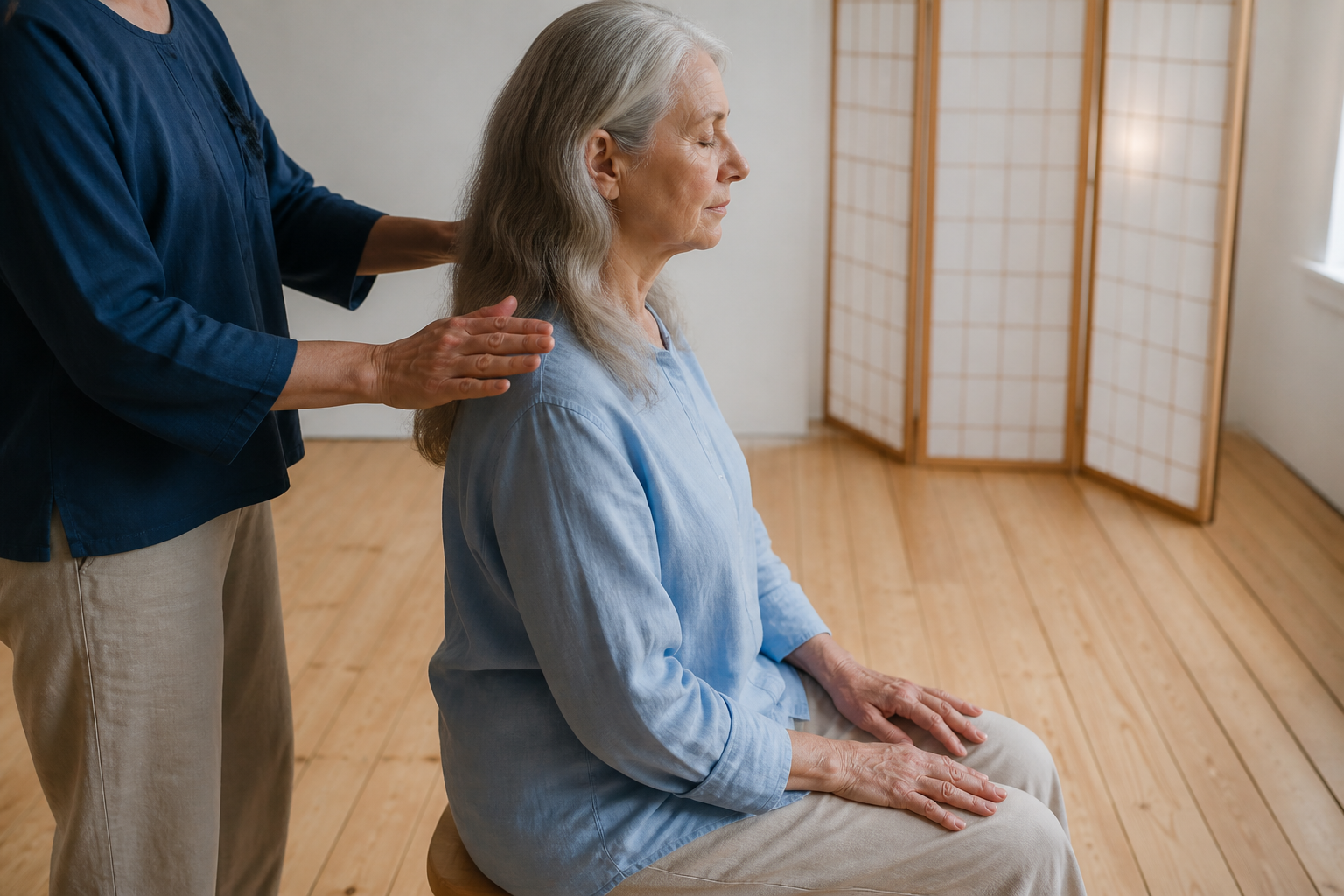
Whatever the explanation, the observable session is simple. You stay fully clothed and lie on a treatment table or sit in a chair. The practitioner asks how you are and whether you prefer hands-on or hands-off contact. They then move through a series of positions, usually from the head down, resting their hands for a few minutes in each place. There is no massage, pressure or manipulation. Sessions last 30 to 60 minutes and end with a short conversation about how you felt. The step-by-step version, including what to ask beforehand, is in what happens in a Reiki session.
People commonly report warmth, tingling, heaviness, drifting in and out of sleep, or nothing at all beyond feeling rested. None of these is required and none proves anything about energy. The benefits people report, and what evidence supports, are covered separately.
How Reiki differs from similar practices
| Practice | What it involves | How Reiki differs |
|---|---|---|
| Massage | Pressure and manipulation of muscle and soft tissue by a trained, often licensed, therapist | Reiki uses only still, light touch or no touch; no tissue work, no undressing, no licence required in most places |
| Meditation | A solo attention practice, often breath-focused | Reiki is usually received from another person; self-Reiki adds hand positions to a meditation-like rest |
| Faith healing | Prayer or laying-on of hands within a religious framework | Reiki has no required beliefs or deity; its explanation is energetic rather than devotional |
| Physiotherapy or medical care | Diagnosis and evidence-based treatment by regulated professionals | Reiki does not diagnose or treat; it is a complementary comfort practice alongside care, never a replacement |
Training and lineage
Most Usui-style schools teach three levels: a first level for self-practice and family, a second that introduces the symbols and distance practice, and a master or teacher level. Each level includes an attunement. Courses range from a single day to longer apprenticeships, and there is no licensing body or protected title in most countries, so quality varies. The beginner’s guide to Reiki explains what to expect from a first course, and how to do Reiki walks through self-practice for people who want to try before they commit.
Reiki for animals, briefly
Many practitioners offer Reiki to pets, and animals often settle when a calm person sits quietly beside them with a light hand. That is a reasonable thing to do for a nervous dog or an elderly cat, provided the animal can move away, is never restrained, and any illness is seen by a vet. Reiki for pets sets out how to keep it welfare-first.
Holding the tradition and the evidence together
You do not have to choose between “Reiki is real” and “Reiki is nonsense”. A more accurate position is that Reiki is a real practice with a real history and real effects on how people feel, whose traditional explanation has not been supported by research and whose medical claims should not be made. That leaves plenty of room to enjoy it. The place to be careful is wherever Reiki is offered as a treatment: for a diagnosed illness, in place of medication, or as an explanation for a symptom that has not been examined. The Reiki safety guide lists those red flags.
Key Takeaways
- Reiki began with Mikao Usui in 1920s Japan and reached the West through Hawayo Takata.
- The five precepts are everyday ethical guidance that need no belief in energy.
- A session is light touch or no touch, fully clothed, 30 to 60 minutes, with no manipulation.
- The energy explanation belongs to the tradition; research has not found it or any treatment effect.
- Enjoy Reiki as a comfort practice; keep diagnosis and treatment with qualified care.
Related reading
- What does research say about Reiki? Evidence and limits
- Reiki benefits: what people report and what the evidence supports
- How to do Reiki: self-practice, training and limits
- Japanese Reiki techniques: gassho and joshin kokyu ho
- Preparing for a Reiki attunement
Frequently Asked Questions
1. What does the word Reiki mean?
It combines the Japanese words rei, meaning spirit or universal, and ki, meaning life energy. The tradition uses it to describe a universal energy the practitioner is said to channel.
2. Who founded Reiki?
Mikao Usui, a Japanese lay Buddhist, developed the practice in the early 1920s and began teaching it in Tokyo.
3. How did Reiki reach the West?
Hawayo Takata trained under Usui’s student Chujiro Hayashi in the late 1930s and taught in Hawaii and the United States until 1980, training twenty-two masters who spread it further.
4. What are the five Reiki precepts?
Just for today: do not anger, do not worry, be grateful, work honestly, be kind to others. They are ethical guidance rather than a technique.
5. Is Reiki a religion?
No. It has Buddhist and Shinto influences but no required beliefs, and people of any faith or none practise it.
6. What happens during a Reiki session?
You stay clothed, lie or sit, and the practitioner rests their hands on or just above your body in a series of positions for 30 to 60 minutes. There is no pressure or manipulation.
7. Do I have to believe in Reiki for it to work?
You do not need to believe anything to feel relaxed during a quiet session. Whether belief affects the experience is exactly what research cannot separate out.
8. Is the Reiki energy real?
No scientific evidence supports the existence of the energy field described in Reiki. It remains the tradition’s explanation rather than an established fact.
9. Does Reiki treat illness?
No. Research has not shown Reiki to be useful for any health condition. It can sit alongside medical care as a comfort practice.
10. How is Reiki different from massage?
Massage works muscle and soft tissue with pressure. Reiki uses still, light touch or no touch at all, with no undressing and no manipulation.
11. What is an attunement?
A short ceremony in which a teacher initiates a student into the practice. Within the tradition it opens the student to Reiki; practically it marks that they have been taught.
12. What is a Reiki lineage?
The chain of teachers linking a practitioner back to Usui, usually through Takata. It signals authenticity within the tradition but says nothing about effectiveness.
13. Can I learn Reiki myself?
Yes. Self-practice needs no training; a Level 1 course adds the tradition’s structure and an attunement, and is usually a one- or two-day event.
14. Can Reiki be done on animals?
Many people sit calmly with a pet and a light hand. Keep it welfare-first: the animal can leave at any time and any illness goes to a vet.
15. Is Reiki regulated?
In most countries there is no licence or protected title, so ask about training, insurance and how a practitioner describes what Reiki can and cannot do.
Final thoughts
Understanding Reiki means holding two things at once: a century-old practice with a clear history, a gentle ethic and a session that many people find restful, and a traditional explanation that science has not confirmed. Keep those apart and Reiki stays what it is at its best, a calm hour that asks nothing of your medical care and promises nothing it cannot deliver.
Evidence statements checked against the NCCIH Reiki overview on 26 September 2026.
The history of Reiki and Dr. Mikao Usui’s contributions are fascinating. It’s notable how cultural practices can transcend geographical borders and influence global well-being.
The mention of Reiki being used alongside medical treatments like chemotherapy is an interesting point. Complementary therapies can sometimes enhance the overall treatment experience for patients.
While the article highlights numerous benefits of Reiki, it would be beneficial to cross-reference these with peer-reviewed studies to understand the extent of its efficacy in clinical settings.
The article provides a comprehensive overview of Reiki and its benefits. However, it would be interesting to see more scientific evidence supporting the claims made about its effectiveness.
The principle of living ‘just for today’ is quite insightful. It reminds me of various mindfulness practices that emphasize living in the present moment.
The idea of channeling positive energy through touch resonates well with various traditional healing practices around the world. It’s intriguing to see how Reiki integrates into modern wellness routines.