
Quick Guide
Hon Sha Ze Sho Nen is the third of the four traditional Usui Reiki symbols, taught at Level 2 and used for distance practice. Its name is usually rendered as “no past, no present, no future” and it is drawn as a tall stack of stylised Japanese characters. Within the tradition it is the focus a practitioner uses when offering Reiki to someone not present. Outside it, the symbol is a meditation aid with no effect on anyone else, and claims that it opens “Akashic records”, heals past lives, or can be set to “repeat automatically” have no basis. This guide explains what the symbol is, what it means to practitioners, how it is used, and where the claims stop.
The old version of this page said the distance symbol gives “access to the Akashic Records”, works on the receiver’s “subtle body”, can be sent “to the future” or “to the past”, and can be set up “to automatically repeat”. It also said the recipient “is likely to feel it happening”. None of that is supportable. What the symbol actually is, and how thoughtful practitioners use it, is more interesting than the mythology and takes less explaining.
What the symbol is
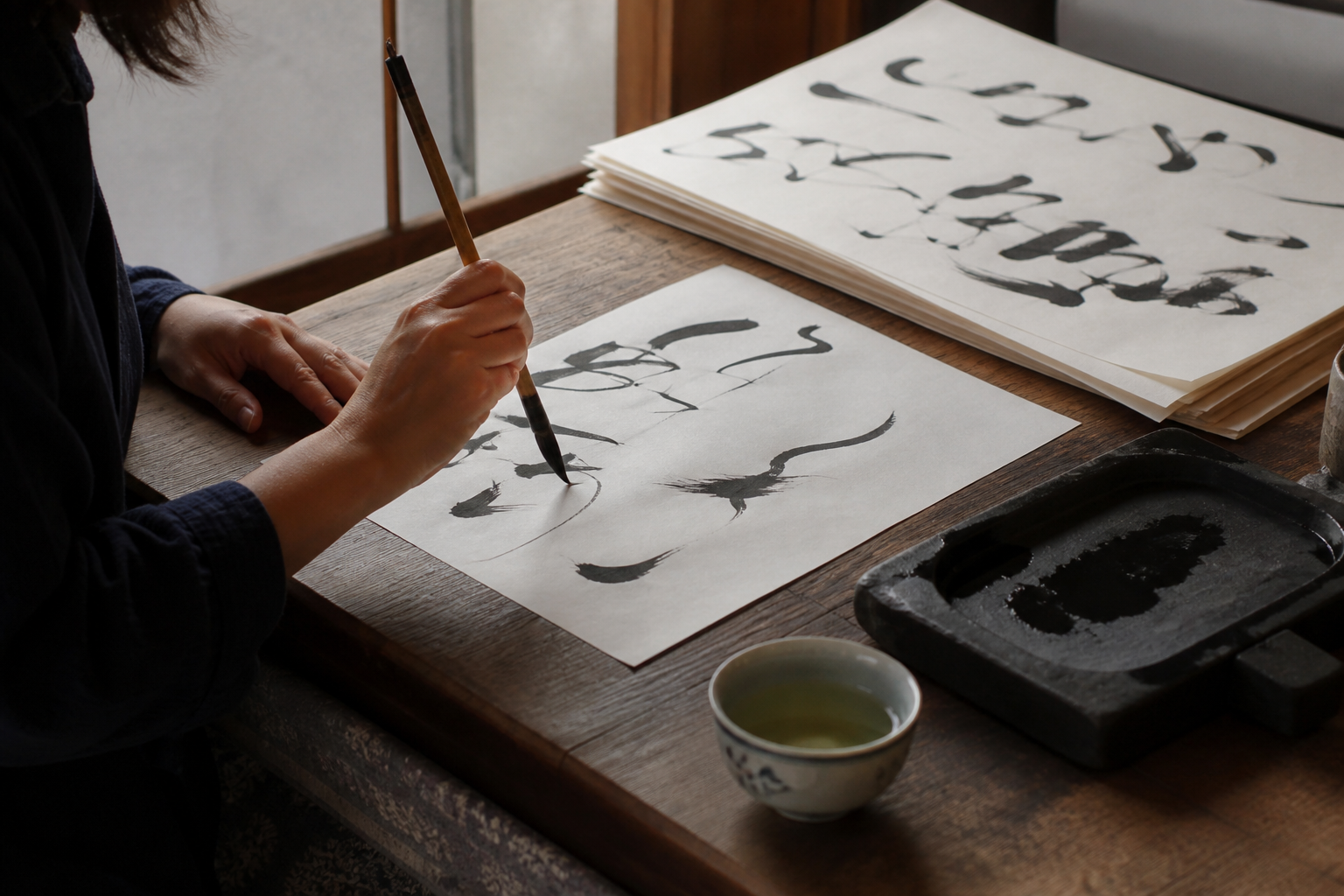
Hon Sha Ze Sho Nen is a composite of Japanese kanji stacked and simplified into a single vertical form. The characters, read individually, carry meanings along the lines of origin or root, person, correct or true, thought or mind, and the whole is conventionally glossed as “no past, no present, no future” or, more loosely, “the origin of all is pure consciousness”. The old article’s claim that the symbol represents the five Chinese elements and the chakras is a later interpretation, not part of the form. Because it is the longest of the four symbols and passed hand to hand for a century, it has more drawing variations than any other, which is why one lineage’s version can look quite different from another’s.
Some lineages ask students not to publish the symbols and treat them as sacred; others regard them as freely available. This site does not reproduce them, out of respect for the first view, and because the form of the symbol has no bearing on what the practice does.
What it means to practitioners
Within Reiki, energy is not thought of as travelling from one place to another; it is described as universal and already everywhere. The distance symbol is therefore not a transmitter. It is the practitioner’s way of setting aside the idea of separation, “no past, no present, no future”, so that offering Reiki to someone in another city is felt to be no different from offering it to someone on the table. The phrase sometimes attached to it, “the Buddha in me greets the Buddha in you”, captures the same idea: a statement of connection, not a mechanism. Understanding long-distance Reiki covers the practice as a whole.
How it is used
- The practitioner sits quietly at an agreed time, often with a photograph, a written name or simply the person in mind.
- The symbol is drawn in the air, on the palm, or visualised, sometimes with the other Level 2 symbols before and after it, and its name is said silently three times.
- Hands are held as for a session, over a cushion, a knee, or a stand-in object, for fifteen to thirty minutes.
- The session is closed as any other, and the practitioner may send a message afterwards.
Methods vary between teachers; the old article was right that ten masters in a room would each do it differently. That is because the steps are a framework for the practitioner’s attention, and attention does not need a fixed procedure.
Where the claims stop
| Claim | Status |
|---|---|
| The symbol lets Reiki reach someone far away | The tradition’s belief. There is no mechanism and no evidence that anything reaches anyone; the NCCIH finds no support for the energy at all. |
| The recipient will feel it happening | Only if they know the time and choose to rest then, in which case they feel the rest. Blinded tests do not show recipients detecting when Reiki is being sent. |
| It gives access to the Akashic records | A Theosophical idea from the late nineteenth century, not part of Usui’s teaching, and not something anyone has demonstrated. |
| It heals past lives, parallel lives, or trauma from this life | No. Trauma is processed with a trained therapist; past lives are a belief, not a treatment target. |
| It can be sent to the future to help with a task | A ritual of good wishes for a coming event. Harmless if understood that way; nothing acts on the future. |
| It can be set to repeat automatically | Nothing is being sent, so nothing can be scheduled. A practitioner who charges for “ongoing sending” is charging for nothing. |
| It works on the subtle body, chakras and aura | None of these has been detected. The phrase explains why no physical effect is seen by moving the claim somewhere it cannot be checked. |
A respectful way to hold the symbol
None of this means a practitioner should stop using Hon Sha Ze Sho Nen. As a focus for goodwill towards someone who has asked for it, at a time they know about, it is a coherent and often comforting practice for both parties. The honest version keeps three things straight: it is done only for people who asked; it is described as intention rather than treatment; and it is never sold as if something were delivered. Distance Reiki sessions sets out what a live online session is worth compared with unattended sending, and the Reiki safety guide covers the claims to avoid.
For victims of disasters. Old articles often suggest sending Reiki to people affected by a calamity. If that helps you feel less helpless, there is no harm in it, but it does nothing for them. Money to a reputable relief organisation does.
Key Takeaways
- Hon Sha Ze Sho Nen is the Level 2 distance symbol, a stack of stylised kanji glossed as “no past, no present, no future”.
- Within the tradition it expresses connection rather than transmission; outside it, it is a meditation aid with no effect on others.
- Akashic records, past-life healing, sending to the future and automatic repeats have no basis.
- Recipients feel rest if they rest; they do not detect sending.
- Use it, if at all, for people who asked, as intention, never as a paid delivery.
Related reading
- Understanding long-distance Reiki: the practice, the tradition and its limits
- Distance Reiki sessions: what you are buying, what to pay, what to avoid
- How does Reiki work? Tradition vs evidence
- Is Reiki channelled energy?
- Understanding Reiki: history, principles and what a session involves
Frequently Asked Questions
1. What is Hon Sha Ze Sho Nen?
The third traditional Usui Reiki symbol, taught at Level 2, used as the focus for distance practice. It is a vertical stack of stylised Japanese characters.
2. What does the distance symbol mean?
It is usually glossed as “no past, no present, no future”. Practitioners understand it as a statement of connection rather than a mechanism.
3. How is it pronounced?
Roughly “hon-sha-zay-show-nen”. Pronunciation varies slightly between lineages.
4. Why does the symbol look different in different lineages?
It is the longest of the four symbols and was passed hand to hand for a century, so drawing variations accumulated. The differences do not matter to what it does.
5. Does the symbol send Reiki across distance?
That is the tradition’s belief. There is no mechanism and no evidence that anything reaches anyone.
6. Will the person feel Reiki being sent?
Only if they know the time and choose to rest then. Blinded tests do not show recipients detecting when Reiki is being sent.
7. Does it open the Akashic records?
No. That is a late-nineteenth-century Theosophical idea, not part of Usui’s teaching, and nobody has demonstrated it.
8. Can it heal past lives or trauma?
No. Trauma is processed with a trained therapist. Past lives are a belief, not something a symbol acts on.
9. Can Reiki be sent to the future or the past?
Practitioners sometimes do this as a ritual of good wishes or reflection. Nothing acts on past or future events.
10. Can distance Reiki be set to repeat automatically?
No. Nothing is being sent, so nothing can be scheduled. Paying for ongoing sending is paying for nothing.
11. Does the symbol represent the five elements and the chakras?
That is a later interpretation, not part of the symbol’s form or Usui’s teaching.
12. Are the Reiki symbols secret?
Some lineages keep them confidential; others publish them. This site does not reproduce them, and the form has no bearing on what the practice does.
13. Do I need permission to use the symbol for someone?
Most lineages say yes, and it is the right rule: send only for people who asked, and keep it private otherwise.
14. Is there any value in the practice?
As focused goodwill towards someone who asked, at a time they know about, it can be comforting for both parties. Described as intention rather than treatment, it is coherent.
15. Should I send Reiki to disaster victims?
If it eases your own helplessness, there is no harm. It does nothing for them; a donation to a reputable relief organisation does.
Final thoughts
Hon Sha Ze Sho Nen is a beautiful idea expressed in a stack of borrowed characters: that separation is not the whole story and that goodwill does not need proximity. Held as that, it is a fine thing for a practitioner to draw. Sold as a way to reach the Akashic records, heal past lives or deliver energy on a schedule, it becomes a claim that cannot be kept. The symbol has never needed the second story, and the people who receive its goodwill deserve the first.
Evidence statements checked against the NCCIH Reiki overview on 26 September 2026.
The use of Reiki symbols like Hon Sha Ze Sho Nen and their complex forms rooted in Japanese Kanji is culturally rich. It underscores the historical and symbolic significance of these practices.
The ability to send Reiki energy across time—both to the past and the future—is a compelling concept. It brings a unique dimension to the practice.
While the idea is engaging, it would be interesting to see empirical evidence that supports the efficacy of such time-transcendent healing methods.
Indeed, the aspect of time in Reiki healing opens up various possibilities. It could potentially address unresolved issues from different phases of life.
The mention of the Akashic Records and their role in karmic healing is thought-provoking. It adds a level of depth to the practice that merits further investigation.
It’s fascinating to see how different practitioners have unique methods for distance healing. It makes me wonder about the underlying principles that guide this practice.
The concept of distance healing through Reiki is quite intriguing. The idea that energy can transcend physical limitations is something worth exploring further.
The emphasis on intention in Reiki distance healing is noteworthy. It highlights the importance of mental focus and clarity in the healing process.