

Quick Guide
There are two answers to “how does Reiki work?”. The tradition’s answer is that a practitioner channels universal life energy to where it is needed. Research does not establish energy transfer or a single explanation for every experience. Rest, optional touch, attention and expectations are possible contributors to how a session feels; none guarantees relaxation or better health. This guide sets out both answers, shows how researchers test the difference, and explains why the ordinary answer is the more useful one for deciding whether Reiki is for you.
Most explanations of how Reiki works either repeat the tradition’s language without comment or wave vaguely at “biofields” and quantum particles. Neither helps you understand what happens on the table. What follows keeps the two explanations separate, gives each its due, and lands on the one you can actually use.
The tradition’s explanation
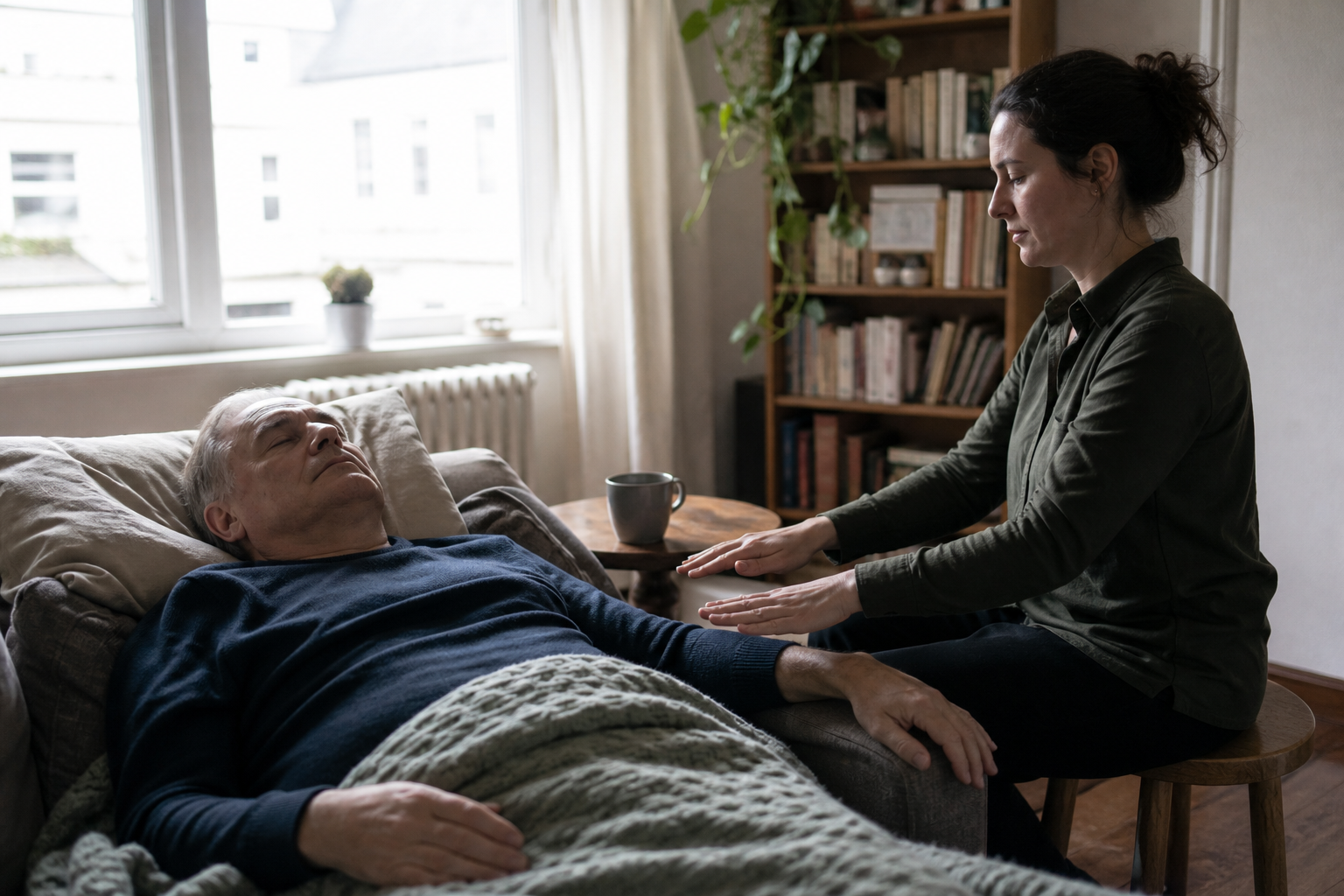
In the Usui system, everything alive is animated by ki, a life energy. Stress, illness and emotional strain are described as disrupting or blocking its flow. A Reiki practitioner, having been attuned by a teacher, acts as a channel through which universal energy passes to the recipient, where it is said to go wherever it is needed and restore flow. The practitioner’s hands are the point of transfer, and the symbols learned at Level 2 are said to focus or direct the energy, including to someone at a distance.
This is a coherent account within the tradition, and it has meaning for many practitioners and recipients. It is also unfalsifiable as stated, which is why it cannot be tested directly. What can be tested is whether a trained practitioner produces effects an untrained one does not. That is the question the research asks.
What research has actually found
The U.S. National Center for Complementary and Integrative Health summarises the position: Reiki has not been clearly shown to be useful for any health-related purpose, and there is no scientific evidence that the proposed energy field exists. Some studies compare Reiki with a sham procedure that imitates the setting or hand positions without the same training. Such comparisons help test whether outcomes differ beyond the shared setting, attention and expectations. Similar outcomes would not demonstrate a Reiki-specific effect; they do not prove exactly which factor caused the experience. The evidence is reviewed in more depth in what research says about Reiki.
Reported comfort matters, but a personal improvement does not identify its cause or establish treatment effectiveness. Study quality, control procedures and uncertainty all matter.
Four possible contributors to the experience
What may shape a session
- RestA quiet, comfortable pause may feel restful. Duration varies, and changes in breathing or heart rate are not guaranteed.
- Light touchSome people welcome gentle contact; others dislike it or prefer no touch. Consent and comfort matter more than any claimed need for contact.
- AttentionFeeling listened to may be supportive. It does not establish why a particular person felt better or prove that all Reiki and sham procedures are equivalent.
- ExpectationExpectations and the setting can influence reported experiences. They do not guarantee a response, and disappointment is not a failure of belief.
These factors are not unique to Reiki and may help explain some reported experiences. They are possible explanations, not a demonstrated recipe for better sleep or a complete account of every outcome.
The relaxation response, briefly
Relaxation practices can influence how a person feels, but a change after a Reiki session does not establish energy transfer or identify its cause. The NCCIH overview of relaxation techniques discusses uses and limitations. Choose a comfortable position, breathe naturally, and stop if the practice makes you uneasy. Do not postpone assessment or treatment to try Reiki.
About biofields and quantum explanations
Measurable electrical activity in the heart or brain is not evidence for the life-energy field proposed in Reiki. Nor does using quantum terminology establish a mechanism or a health benefit. A credible explanation needs a defined claim, appropriate measurements and reliable results, not scientific-sounding language alone.
Practical choices without an energy explanation
- Judge comfort by your own experience without interpreting sensations as proof of healing.
- Choose hands-off contact if you prefer, and withdraw consent at any time.
- A quiet rest at home is an option; how to do Reiki describes a comfortable self-practice with limits. Equivalent benefits are not established.
- Keep assessment and treatment with qualified health professionals.
- Be cautious about guaranteed results, diagnoses of energy blocks, or pressure to buy repeat sessions.
On “you must be open to it”. You do not owe a practitioner belief or a particular response. Expectations may affect experience, but a session that does not help is not your fault. You can stop or decline further sessions.
What this means for pain and illness
Reiki is not an established treatment for pain or illness. Feeling more comfortable after a session does not show that its cause has been treated. For persistent, worsening or concerning pain, seek clinical advice; urgent symptoms need urgent care. If you choose a session for comfort, keep your care plan in place. The Reiki safety guide explains these boundaries.
Key Takeaways
- Energy transfer is the tradition’s explanation, not an established scientific mechanism.
- Rest, optional touch, attention and expectations may influence experience; they do not guarantee an outcome.
- Sham comparisons help test specific effects but do not identify every cause of reported improvement.
- Physics terminology alone is not evidence for Reiki.
- Comfort does not replace diagnosis or treatment.
Related reading
- What does research say about Reiki? Evidence and limits
- Understanding Reiki: history, principles and what a session involves
- How can Reiki help you? Where it fits and where it doesn’t
- Reiki benefits: what people report and what the evidence supports
- What happens in a Reiki session: step by step
Frequently Asked Questions
1. How does Reiki work according to the tradition?
A practitioner attuned by a teacher channels universal life energy through their hands to the recipient, where it is said to restore the flow of energy and remove blocks.
2. How does Reiki work according to research?
Research has not established a Reiki energy mechanism. Rest, optional touch, attention and expectations may influence experience, but their contribution to a particular session is uncertain.
3. What is sham Reiki?
A comparison procedure that imitates aspects of Reiki without the same training. It helps test specific effects beyond the shared setting; similar outcomes do not prove which factor caused them.
4. Is there a Reiki energy field?
No scientific evidence supports one. The NCCIH states there is no evidence the proposed energy field exists.
5. Why does my heart rate drop during Reiki?
Relaxation or other factors may influence heart rate, but a change is not guaranteed and cannot be attributed to energy transfer. Seek clinical advice for concerning symptoms rather than treating a session as a test.
6. Does the body’s electrical or magnetic field explain Reiki?
Measurable electrical activity in the heart or brain does not establish the energy field proposed in Reiki or a healing effect.
7. Do quantum physics explanations support Reiki?
Quantum terminology alone does not establish a Reiki mechanism or benefit. A scientific claim needs appropriate measurements and reliable evidence.
8. Does Reiki work if I am sceptical?
You can attend without accepting energy claims. You may or may not find it restful; lack of benefit is not a failure of belief.
9. Why do people feel warmth or tingling?
Warmth or tingling can have ordinary explanations and does not establish energy transfer. New, persistent or concerning sensations deserve clinical advice rather than an energy diagnosis.
10. Does hands-off Reiki work as well as hands-on?
There is no established rule that one gives equivalent or better benefits. Choose whether touch is comfortable for you, and remember you can decline or stop it.
11. Can Reiki reduce pain?
Some people report comfort, but Reiki is not an established pain treatment. Improvement does not show its cause was treated; keep clinical assessment and your care plan in place.
12. Can Reiki treat illness?
Reiki is not an established treatment for illness. Do not use it to diagnose symptoms, replace treatment or delay medical care.
13. What is the placebo effect in Reiki?
Expectations and context can influence reported experiences. Such effects do not mean symptoms are imaginary or establish that Reiki treats their cause.
14. Can I get the same effect at home?
Quiet rest or a comfortable self-practice may suit you. The same effect as a paid session is not established, and neither should replace needed care.
15. How can I tell if a practitioner is overclaiming?
Watch for promised cures, energy diagnoses, pressure to stop treatment, or escalating payments for guaranteed recovery. Spiritual beliefs do not establish medical effectiveness.
Final thoughts
A session may offer a comfortable pause, but the proposed energy explanation and health benefits are not established. Choose consent, realistic expectations and a cost you can afford, while keeping medical care separate.