

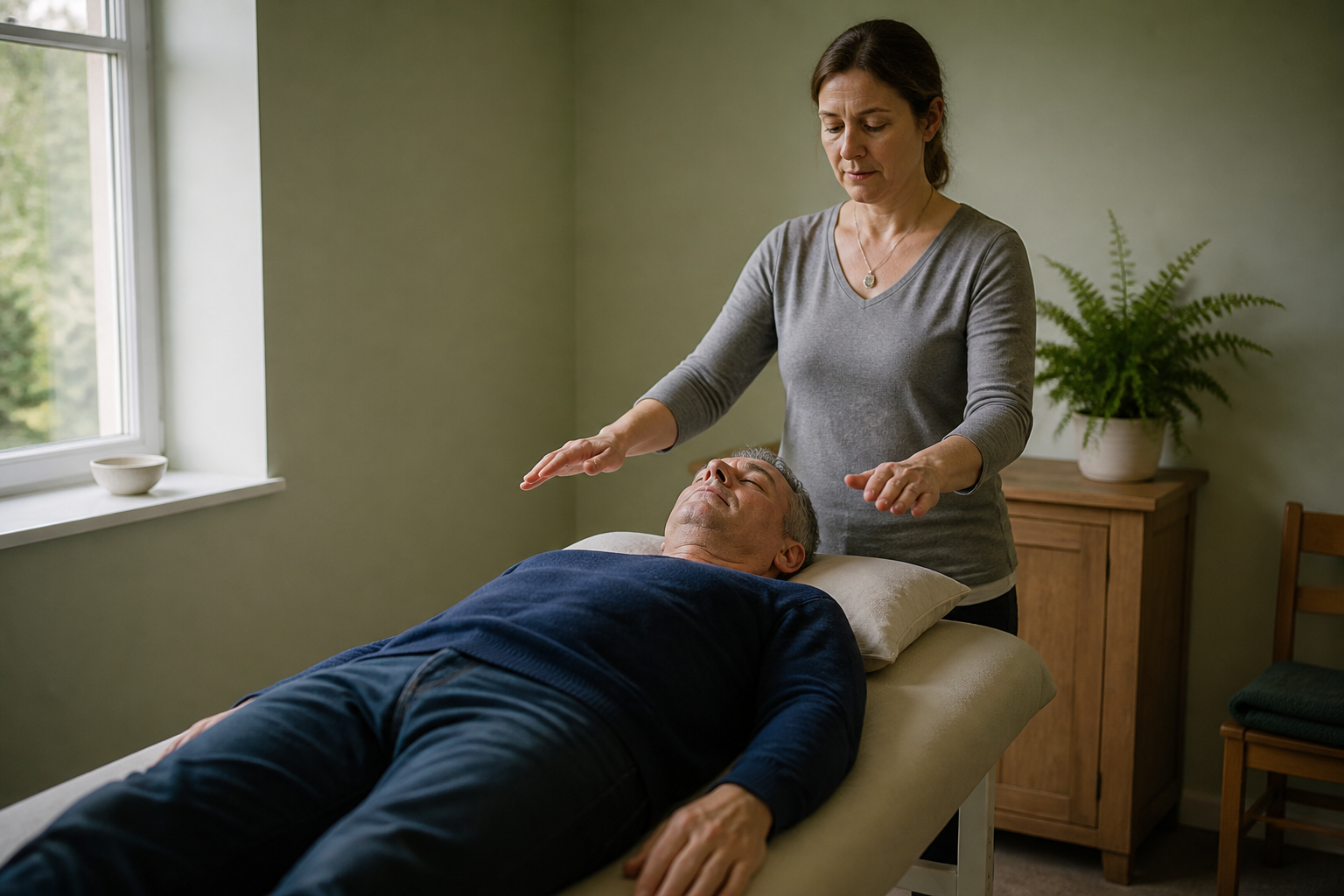
Quick Guide
The benefits people most often report from Reiki are feeling calmer, sleeping better on the night of a session, and enjoying a quiet, attentive hour. Those experiences are real and worth having. What research does not show is that Reiki treats pain, asthma, depression, migraine or any other condition. This guide separates the two, explains why the difference matters, and gives you a fair way to decide whether Reiki is worth it for you.
Search for “Reiki benefits” and you will find lists that run from stress relief to curing arthritis. Some of those claims describe what people feel; others are medical promises that no study supports. If you are deciding whether to book a session or learn the practice, you deserve a list that tells you which is which.
The benefits people commonly report
Ask people who have had a Reiki session what they got from it, and the answers cluster around a small number of experiences. These are consistent across surveys and practitioner reports, and there is nothing mysterious about them.
What a session usually delivers
- Deep relaxationLying still for 45 minutes with light touch and no phone is rare in most people’s week. Many describe it as the most relaxed they have felt in months.
- A calmer mood afterwardsPeople often say they feel lighter or less irritable for the rest of the day, similar to the after-effect of a massage or a long walk.
- Easier sleep that nightReports of falling asleep faster are common. A slow evening session and a quiet ride home probably contribute.
- Being listened toA practitioner who asks how you are and then gives you undivided attention is, for many people, the most valuable part.
These are experiences, not measured outcomes. They can matter a great deal without proving anything about energy or illness.
Two further benefits are worth naming because they are less obvious. First, a regular session can become a fixed point in the week that stops you from running on empty, in the way a class or a walk with a friend might. Second, for people learning self-Reiki, the daily routine of sitting still with light hands is a habit that some find easier to keep than formal meditation. Self-Reiki practice covers how to set that up.
What research can and cannot confirm
The U.S. National Center for Complementary and Integrative Health summarises the evidence bluntly: Reiki has not been clearly shown to be useful for any health-related purpose, and there is no scientific evidence that the energy field it describes exists. Studies that exist are mostly small, short and hard to blind, because the person receiving Reiki can usually tell whether the practitioner is trained or simply going through the motions.
That does not mean the relaxation people report is imaginary. It means researchers cannot separate a Reiki-specific effect from the effects of resting, being attended to, and expecting to feel better. When a trial compares Reiki with “sham Reiki” delivered by an untrained person, the two groups often report similar improvements. That is a useful finding: it suggests the setting and the attention are doing much of the work.
For a longer explanation of how to read Reiki studies, including what comparison groups and effect sizes mean, see what research says about Reiki.
Claims to be careful with
The old version of this article said Reiki could “get rid of asthma, menopausal symptoms, headaches, migraines, arthritis and more” and that it made the body “stronger than conventional medicine does”. Neither statement is supported, and the second is potentially dangerous. Here is how common claims hold up.
| Claim | Status | A fair way to say it |
|---|---|---|
| “Reduces stress” | Commonly reported, not proven as a treatment | “Most people feel calmer during and after a session.” |
| “Improves sleep” | Commonly reported for the night of a session | “Many people sleep well after an evening session.” |
| “Relieves chronic pain” | Mixed, small studies; cannot separate from rest and attention | “Some people feel more comfortable afterwards; it is not a pain treatment.” |
| “Treats asthma, arthritis, migraine” | No supporting evidence | Do not make this claim. |
| “Helps depression or anxiety disorders” | Not a treatment; may be a pleasant addition for some | “Can sit alongside therapy or medication, never instead of it.” |
| “Balances chakras or clears blocks” | A description within the tradition, not a measurable effect | “Practitioners describe it this way; it has not been detected.” |
| “Safe in pregnancy and alongside treatment” | Generally low-risk as a relaxation practice | “Tell your care team; avoid pressure and skip painful or treated areas.” |
Advertising regulators take the same line. The U.S. Federal Trade Commission’s health-claims guidance expects objective health claims to be backed by competent scientific evidence. “I found it relaxing” needs no evidence; “it cures migraines” does, and none exists.
Why the distinction protects you
It is tempting to think the wording does not matter as long as people feel better. It matters for three reasons. Someone who believes Reiki treats asthma may skip an inhaler. Someone who is told their pain is an “energy block” may delay a scan that would have found a treatable cause. And someone who pays for twelve sessions to “clear” a condition will feel cheated when it does not clear, even though the sessions themselves may have been pleasant. Honest expectations keep the good part of Reiki intact and keep medical care where it belongs. The Reiki safety guide lists the red flags to watch for in a practitioner.
Who tends to find Reiki worthwhile
- People who struggle to switch off and want a structured hour of rest with another person present.
- People who find touch comforting, or who prefer hands-off contact and want that respected.
- People going through a hard stretch who want something gentle alongside proper care.
- People drawn to the ritual and spiritual side, for whom the meaning is the point.
Who may be disappointed
- Anyone expecting a symptom to change because of the session.
- People who dislike lying still or being touched by a stranger.
- Anyone who was told Reiki would replace a treatment, medication or appointment.
- People on a tight budget who would get the same rest from a nap, a bath or a walk.
A fair way to judge it for yourself
- Set a plain expectation. “I want an hour of rest and to see whether I feel calmer afterwards.” Nothing about symptoms.
- Book two or three sessions, not a package. Enough to get past first-visit nerves, not enough to sink money into.
- Write one line after each session. How you felt that evening and the next morning. Keep it honest and short.
- Compare with a free alternative. On another week, spend the same hour resting at home and write the same line.
- Decide on that record. If Reiki gives you something the free hour did not, it is worth its price to you. If not, you have lost little.
What sessions and training cost
Prices vary widely by country and city. A session typically costs about as much as a massage of the same length in the same area, and a Level 1 course is usually a one- or two-day event. Ask what is included, whether the practitioner is insured, and what the cancellation terms are. Be wary of anyone who ties price to a promised outcome or who says you must buy a block of sessions before you notice any benefit. If you would rather try a practitioner or reader online first, our comparison of Reiki and psychic services lists what to check on each platform; a listing verifies terms, not abilities.
Key Takeaways
- The real benefits are relaxation, a calmer mood, easier sleep that night and being attended to.
- Research cannot separate a Reiki-specific effect from rest, attention and expectation.
- Claims about treating asthma, arthritis, migraine, depression or pain are unsupported and should not be made.
- Keep medical care in place; Reiki sits beside it, never instead of it.
- Judge it by your own short, honest record against a free alternative.
Related reading
- How to do Reiki: a beginner’s guide to self-practice and training
- What does research say about Reiki?
- Reiki safety guide: risks, boundaries and medical care
- 7 Reiki claims: what to check before booking
- Reiki and depression: evidence, comfort and care choices
- What happens in a Reiki session
Frequently Asked Questions
1. What are the main benefits of Reiki?
The benefits people most often report are deep relaxation during the session, a calmer mood afterwards, easier sleep that night, and the experience of being listened to. These are experiences rather than proven health effects.
2. Is Reiki scientifically proven?
No. The NCCIH summary finds no clear evidence that Reiki is useful for any health purpose, and no evidence for the energy field it describes.
3. Can Reiki reduce stress?
Most people feel calmer during and after a session. Studies cannot tell whether that comes from Reiki itself or from resting quietly with someone’s full attention.
4. Does Reiki help you sleep?
Many people report sleeping well on the night of a session, especially an evening one. There is no evidence it treats insomnia.
5. Can Reiki relieve pain?
Some people feel more comfortable afterwards. Research is small and mixed and cannot separate a Reiki effect from rest and expectation. It is not a pain treatment.
6. Does Reiki treat asthma, arthritis or migraine?
No. There is no evidence for these claims, and relying on Reiki instead of treatment for such conditions is unsafe.
7. Can Reiki help with depression or anxiety?
Some people find sessions calming, but neither condition should be managed with Reiki alone. Keep therapy and medication in place and discuss any complementary practice with your clinician.
8. What is sham Reiki and why does it matter?
Sham Reiki is a comparison in studies where an untrained person mimics a session. When both groups report similar benefits, it suggests attention and rest explain much of the effect.
9. Is Reiki safe?
As a light-touch relaxation practice it is generally low-risk. The main risks are delaying medical care or having pressure applied to an injured or treated area.
10. Can I have Reiki during pregnancy?
Light, hands-off or gentle sessions are generally considered low-risk, but tell your midwife or doctor and avoid pressure on the abdomen.
11. How many sessions do I need to feel a benefit?
If a session is going to relax you, you will usually know after one or two. Be wary of advice that benefits only appear after buying a large package.
12. Does Reiki balance chakras or clear energy blocks?
That is how the tradition describes it. The energy and the blocks have not been detected scientifically, so treat it as language within the practice, not a measurable result.
13. Is self-Reiki as beneficial as a session with a practitioner?
For relaxation, a daily self-practice can be just as useful and costs nothing. What you lose is the other person’s attention, which some people value most.
14. Can Reiki replace medical treatment?
No. It should never replace diagnosis, medication, therapy or urgent care. It can sit alongside them as a comfort practice.
15. How do I tell whether Reiki is worth it for me?
Set a plain expectation, try two or three sessions, keep a one-line note after each, and compare with an hour of rest at home. Decide on that record.
Final thoughts
Reiki’s real benefits are modest, pleasant and worth describing accurately: an hour of rest, a calmer evening, sometimes a better night’s sleep, and the attention of someone whose only job for that hour is you. Those things do not need a cure claim attached to be valuable. Keep your expectations plain, keep your medical care where it is, and let your own short record decide whether Reiki earns a place in your week.
Evidence statements checked against the NCCIH Reiki overview on 26 September 2026.
Learning Reiki through online courses sounds practical and accessible. It’s good to know that it can complement other health treatments.
Indeed, the ease of learning from home is quite a plus. Reiki could be an interesting addition to conventional health practices.
Online learning could make Reiki more approachable for many. It seems like a valuable addition to a wellness routine.
The mention of balancing the chakras and the systems of the body caught my attention. It’s intriguing how Reiki can aid in physical and emotional well-being.
The link between Reiki and improved sleep quality is quite compelling. Adequate rest is indeed crucial for overall health.
I appreciate the detailed explanation of how Reiki can aid in stress management and promote relaxation. The inclusion of spiritual growth is also fascinating.
It’s noteworthy that Reiki can help with both minor ailments and emotional clarity. The holistic approach seems very beneficial.
The article provides a comprehensive overview of the benefits of Reiki. It’s interesting to see how it can help with mental and emotional balance.