

Kundalini awakening is a spiritual idea associated with profound inner change. People drawn to it may be seeking a closer relationship with themselves, a sense of sacredness in everyday life or a language for an experience that feels difficult to explain.
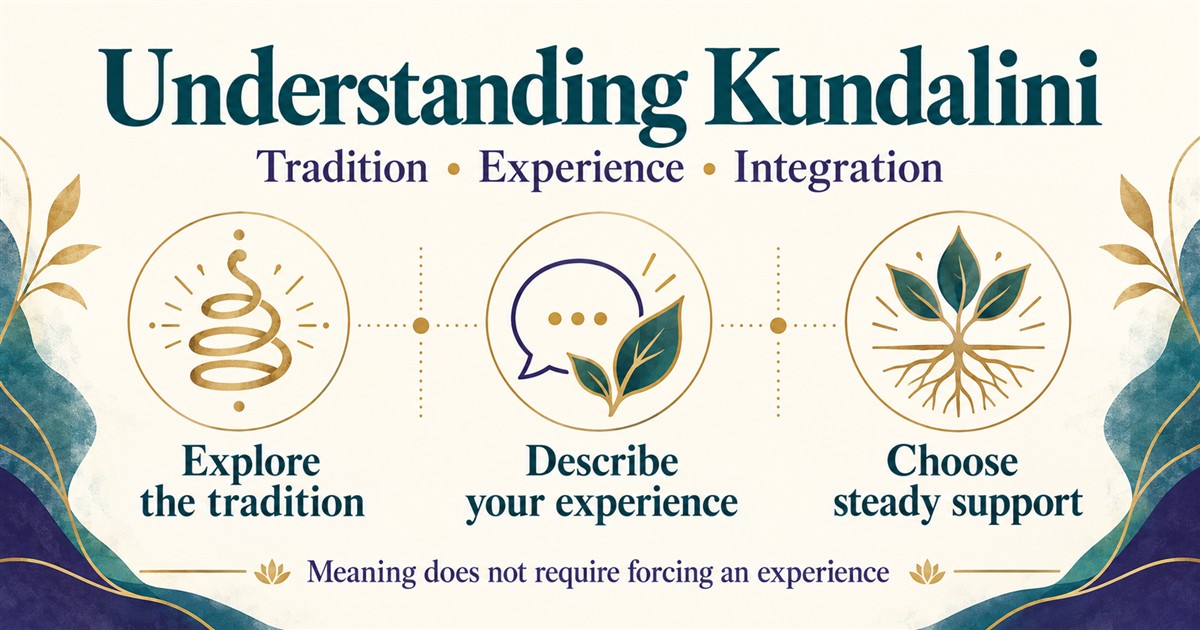
You can explore that meaning patiently. There is no requirement to produce dramatic sensations, reach a particular stage or prove your growth to a teacher. A useful approach makes room for tradition, the experience you actually had and the support that helps you live steadily afterward.
What Kundalini means in its spiritual setting
In some Indian yogic and tantric traditions, Kundalini refers to latent spiritual power, often represented by a coiled serpent at the base of the spine. Teachings describe its awakening and ascent through a subtle-body system of channels and chakras. The Himalayan Institute’s account of prana, chakras and Kundalini explains this within its own spiritual tradition.
This imagery gives practitioners a way to discuss consciousness, spiritual potential and transformation. A subtle-body map is a religious or contemplative framework, rather than an anatomical scan. Traditions and teachers differ in how they explain the imagery and the preparation they consider important.
Spiritual awakening and Kundalini awakening
Spiritual awakening
A broad expression people use for a change in values, awareness, identity or sense of connection. It may develop gradually and may not involve a particular yoga tradition.
Kundalini awakening
A more specific interpretation using Kundalini teachings and subtle-body imagery. Someone may describe an experience this way, but the label alone does not establish the cause of a sensation.
You do not need to force every meaningful change into either category. Ask what has changed in your priorities, relationships or daily choices and which language feels helpful rather than frightening.
How to describe an intense experience
Accounts of awakening can mention warmth, tingling, spontaneous movements, emotional waves, vivid dreams or a strong feeling of connection. These reports are not a reliable test of Kundalini, and their presence or absence cannot measure spiritual attainment. Similar experiences can have different explanations.
Separate observation from interpretation: “I felt warmth during meditation” records something different from “I know an energy channel opened.” You can keep the spiritual interpretation as a possibility while also considering sleep, stress, the practice you were doing and any health concerns.
Feeling grief or anxiety is not proof that old emotions are being cleansed from your body. An intense experience does not make distress necessary or something you must push through. NCCIH’s meditation overview notes that research on harms is limited and that some people report negative experiences. Stop or reduce a practice that increases distress and seek appropriate support.
Choose integration over chasing intensity
Integration means finding a workable place for an experience in everyday life. It might involve returning to a manageable sleep routine, eating in a way that meets your needs, keeping ordinary commitments and talking to someone who listens without insisting on one explanation.
- Quiet attention: Try only a comfortable, manageable period if you want to. You can keep your eyes open, focus outward or choose another activity.
- Sound or prayer: A familiar phrase, chant or prayer can be meaningful. It need not produce a physical sensation or a special state to count.
- Movement: Choose suitable, comfortable activity. Pain, dizziness or involuntary movements are not achievements to intensify.
- Creative expression: Art or private reflection may help you find words for what mattered without deciding exactly what caused it.
- Everyday ethics: Notice whether your practice supports honesty, consent, kindness and respect for other people’s limits.
The source of a feeling does not have to be settled before you arrange practical support. Our daily energy and spiritual-reflection guide offers ordinary options you can adapt without turning wellbeing into a ranking.
Why an activation promise deserves caution
A guaranteed awakening date, a demand to ignore symptoms or a claim that only one paid teacher can keep you safe is a reason to step back. You do not owe anyone intense practice, touch, secrecy or repeated purchases to prove that you are open to spiritual growth.
Breath of Fire, prolonged breath holding, forceful breathing and demanding spinal practices should not be treated as a general beginner experiment or a way to provoke symptoms. NCCIH’s yoga safety guidance recommends qualified instruction, avoiding extreme practices including forceful breathing when new to yoga, and discussing individual needs where health conditions or pregnancy are relevant.
Free experience and integration worksheet
- Describe: What exactly did I notice, and how long did it last?
- Context: What was happening with sleep, stress and the practice I was doing?
- Meaning: What spiritual association do I want to explore, leaving room for uncertainty?
- Daily life: Am I managing ordinary activities and feeling able to choose what I do?
- Next step: Rest, change a practice, ask a teacher a question or arrange qualified care?
This is a reflection aid, not an awakening score or a diagnostic checklist. You can use it mentally and do not need to keep private notes if that would be unsafe.
Find a teacher who respects your choices
Ask about training, the tradition being taught, physical demands, consent, fees and how the teacher responds when a student wants to stop. A responsible guide can acknowledge uncertainty and the limits of their role. Spiritual teaching and clinical care can serve different purposes; you should not be pressured to abandon prescribed treatment.
If you are also considering Reiki, our energy-healing session guide provides questions to ask before booking. Reiki and Kundalini are not interchangeable labels for every spiritual experience.
When an experience needs more than spiritual interpretation
Seek qualified care for new, persistent or distressing symptoms, particularly when sleep, movement, concentration or everyday functioning is affected. Describe what happened in ordinary language; you can also explain its spiritual meaning to you. For immediate danger or a medical emergency, use local emergency services.
Exploring Kundalini can be a thoughtful study of meaning, values and spiritual potential. Let curiosity develop at a pace you can choose, and judge a practice partly by the room it leaves for rest, consent, relationships and ordinary life.
Frequently asked questions
1. What is Kundalini?
In some Indian yogic and tantric traditions, it is latent spiritual power represented by a coiled serpent and described through a subtle-body system. Interpretations vary by tradition.
2. Is the serpent a literal animal in the body?
It is symbolic imagery within spiritual teachings, not an anatomical finding or evidence of an animal inside the spine.
3. Is Kundalini awakening the same as any spiritual awakening?
Not necessarily. Spiritual awakening is a broad term; Kundalini refers to a more particular traditional framework. You need not apply either label to every meaningful change.
4. Does tingling prove Kundalini is awakening?
No. A sensation alone does not identify its cause. Describe what happened and seek care when it is new, persistent, distressing or otherwise concerning.
5. Must an awakening feel dramatic?
No experience is required to prove spiritual growth. Sensations, dreams or emotional intensity cannot serve as a reliable attainment score.
6. Are difficult emotions evidence of cleansing?
Do not assume that. Feelings can have many influences and deserve attention in their own right. Distress does not have to be intensified to make progress.
7. Should I force an activation?
No. You can study spiritual teachings without trying to provoke an intense state or accepting a guaranteed awakening promise.
8. Is forceful breathwork a beginner requirement?
No. NCCIH advises people new to yoga to avoid extreme practices, including forceful breathing. Seek suitable instruction and discuss individual needs when relevant.
9. Can I keep my eyes open during reflection?
Yes. Choose a comfortable approach, including outward attention or another activity. Stop or change a practice that makes you feel worse.
10. Can chanting be meaningful without unusual sensations?
Yes. A chant or prayer can have personal or religious meaning without producing a special state or a measurable energy change.
11. What does integration mean?
It means finding a manageable place for an experience in daily life, including rest, responsibilities, relationships and whatever support you need.
12. How do I choose a teacher?
Ask about training, tradition, physical demands, consent, fees and the freedom to stop. Be cautious about secrecy, pressure and claims that clinical care must be abandoned.
13. Can Reiki and Kundalini be treated as the same thing?
No. They have different contexts and teachings. A spiritual experience does not establish that either explains its cause.
14. When should I seek qualified care?
Seek care for concerning, persistent or distressing symptoms or difficulty functioning. Use local emergency help for immediate danger or a medical emergency.
15. Do I need a paid spiritual service to begin learning?
No. You can start by reading about the tradition, reflecting on your values and asking careful questions. Payment is not proof of growth or a requirement for safety.