
Sound baths may offer a calming group ritual, but research is still developing. Specific tones are not proven to cure disease, clear trauma or “retune” organs.
Quick Guide
- Choose a facilitator who welcomes questions, breaks and lower volume.
- Protect hearing and move farther from gongs or bowls if sound is uncomfortable.
- Treat frequency meanings as spiritual symbolism, not medical dosage.
- Use sound baths as complementary wellbeing practices, not replacement treatment.
Ask
Check volume, instruments, length and accessibility.
Position
Sit or lie where you can move and exit easily.
Listen
Notice comfort; earplugs and breaks are allowed.
Integrate
Hydrate, rest and judge the experience by your response.
What a Sound Bath Actually Is
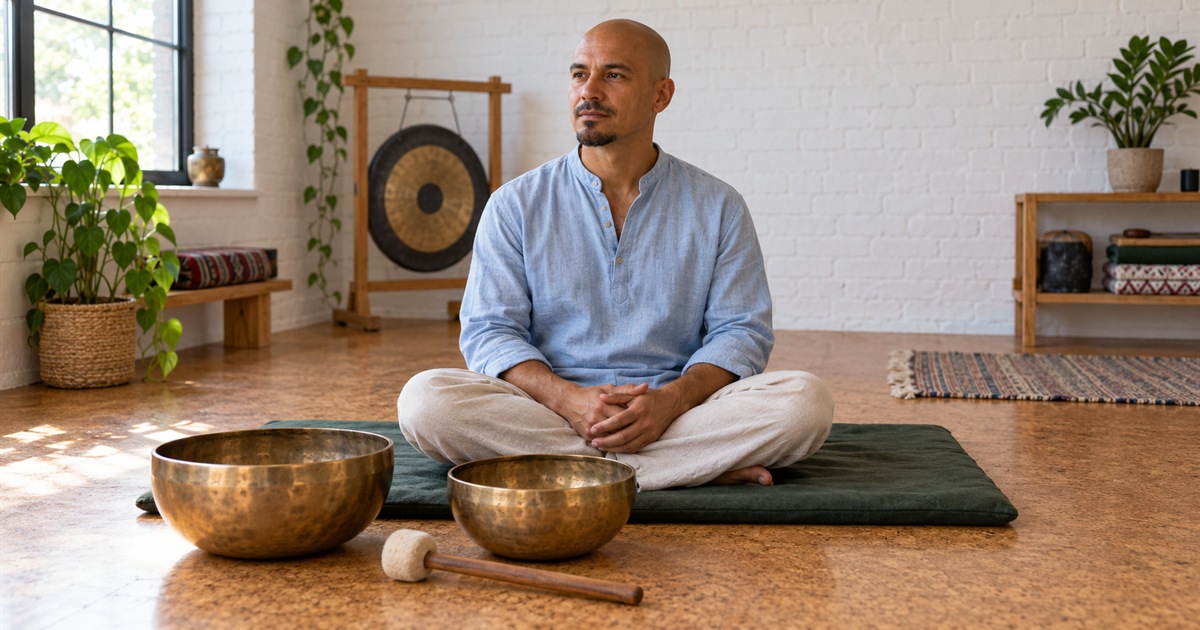
A sound bath is a listening session using instruments such as singing bowls, gongs, chimes, drums or voice. Participants usually sit or lie down while tones unfold. The word “bath” describes immersion in sound, not water. Sessions may include guided breathing, meditation or silence.
People report relaxation, emotion, vivid imagery, sleepiness or sensory discomfort. Expectations, setting, attention, group ritual and the acoustic qualities of the instruments may all shape the experience.
What the Research Suggests
An observational study of 62 adults found lower self-reported tension, anger, fatigue and depressed mood immediately after a singing-bowl meditation. Because there was no randomized control group, the study cannot isolate the bowls from rest, expectation, attention, setting or other factors.
Recent systematic reviews describe possible benefits for anxiety, mood, sleep and some physiological measures, while emphasizing small samples, varied methods and the need for better trials. The responsible conclusion is “promising but preliminary,” not “science proves sound healing.” Immediate before-and-after ratings also do not tell us whether an effect lasts, outperforms quiet rest or works for a diagnosed condition.
Sound Baths Are Not the Same as Music Therapy
The U.S. National Center for Complementary and Integrative Health describes music therapy as a health profession delivered within a therapeutic relationship by a trained practitioner. A general sound bath may be relaxing, but it is not automatically clinical music therapy and should not borrow that profession’s evidence or credentials.
Before booking, ask what training the facilitator has, what the session includes and how they respond to hearing sensitivity, trauma, pregnancy, mobility needs or health concerns. Training in an instrument is not the same as a license to treat disease.
Frequency Claims Need Careful Language
| Claim | What is supportable | What is not established |
|---|---|---|
| “528 Hz repairs DNA” | A tone can be measured in hertz. | Listening to that tone has not been shown to repair human DNA. |
| “Bowls activate the vagus nerve” | Relaxing contexts may affect breathing and arousal. | A bowl is not a validated vagus-nerve treatment. |
| “Sound clears trauma” | Some people find music or ritual emotionally supportive. | A sound bath is not a substitute for trauma-informed care. |
| “Higher vibration means healthier” | Vibration is a physical property; “high vibration” may be spiritual metaphor. | It is not a medical ranking of people or organs. |
For a broader evidence framework, read the site’s guide to mind-body approaches, evidence and safety. Its meditation guide offers quieter practices when intense sound is not a good fit.
Hearing and Sensory Safety
Sound risk depends on loudness and duration. The World Health Organization notes that safe listening time drops quickly as decibel levels rise. You do not need to tolerate pain, ringing, muffled hearing, dizziness or panic for a session to “work.” Move away, use suitable ear protection or leave. Persistent ringing or hearing change deserves professional assessment.
People with migraines, tinnitus, hyperacusis, sensory sensitivities, PTSD or some neurological conditions may prefer a short preview, lower-volume placement or another practice. Ask a clinician about personal medical concerns. Do not place vibrating bowls on the body without informed consent and appropriate competence.
How to Choose a Responsible Session
- Read the description for duration, instruments and participation expectations.
- Ask about average volume, room size and where louder instruments will be placed.
- Confirm that earplugs, seated positions, movement and early exit are welcome.
- Choose comfortable support for your body; lying flat is optional.
- Afterward, evaluate sleep, mood, headache, hearing and overall comfort rather than chasing a promised frequency.
At-home listening
Recordings can provide a quieter, adjustable alternative. Start at a low volume, keep the device away from your ears and stop if tinnitus, headache, dizziness or agitation increases. Do not listen while driving if the recording encourages deep relaxation. Speakers and headphones create different exposure, so comfort—not immersion—is the goal.
The best outcome may simply be an hour of focused listening and rest. That is valuable without turning preliminary findings into a cure. A neutral experience is also valid; you do not need to manufacture tingling, visions or emotional release to participate correctly.
Key Takeaways
- Small studies suggest short-term relaxation and mood benefits, but evidence remains limited.
- Sound baths are not automatically clinical music therapy.
- Specific healing-frequency and disease-treatment claims are not established.
- Volume, duration, consent, sensory needs and freedom to leave are central to safety.
Frequently Asked Questions
1. What is a sound bath?
It is an immersive listening session using bowls, gongs, chimes, voice or other instruments.
2. Are sound bath benefits scientifically proven?
Evidence is preliminary; small studies suggest possible short-term relaxation benefits, but stronger trials are needed.
3. Is a sound bath music therapy?
Not automatically. Music therapy is a credentialed health profession delivered within a therapeutic relationship.
4. Does 528 Hz repair DNA?
No reliable clinical evidence shows that listening to 528 Hz repairs human DNA.
5. Can sound baths treat anxiety?
They may feel calming, but they are not a substitute for assessment or evidence-based anxiety treatment.
6. Can sound baths heal trauma?
They may support relaxation for some people but cannot be assumed to treat trauma and can be activating for others.
7. Are gongs safe for hearing?
Risk depends on loudness, distance and duration; move away or leave if sound is painful or causes ringing or muffled hearing.
8. Can I wear earplugs?
Yes. A responsible facilitator should welcome hearing protection and volume adjustments.
9. What if I have tinnitus?
Ask a hearing professional about your situation and choose lower-volume options; stop if symptoms worsen.
10. Do I have to lie down?
No. Sitting, changing position or leaving early should be acceptable.
11. Are crystal bowls safer than metal bowls?
Material alone does not determine safety; loudness, duration, distance, placement and your response matter.
12. Can bowls be placed on the body?
Only with informed consent and appropriate training; avoid it when there are medical concerns or discomfort.
13. What might I feel afterward?
Some people feel relaxed or emotional; others feel neutral, headachy or overstimulated.
14. How often should I attend?
There is no evidence-based universal schedule; base frequency on comfort, cost and whether it supports rather than replaces care.
15. When should I stop a session?
Stop for pain, panic, dizziness, hearing changes, numbness or any experience that feels unsafe.