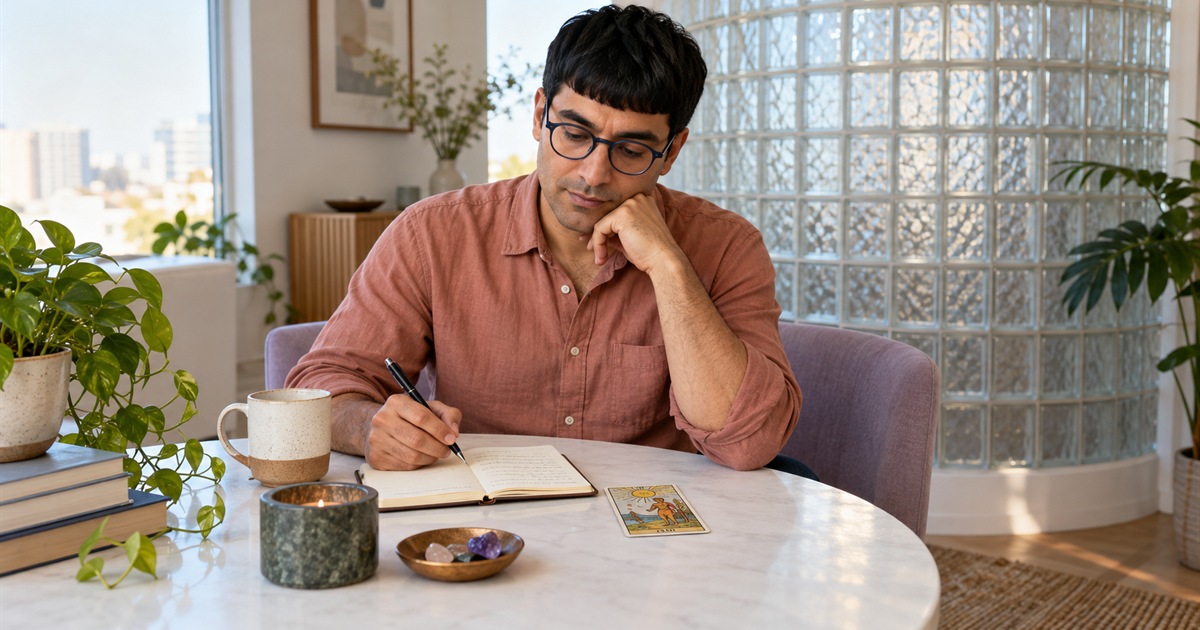
Tarot can provide images and questions that help some people slow down, journal and organize a personal story. That reflective use is different from claiming that cards diagnose a condition, treat symptoms or reveal a guaranteed future. In 2026, the most trustworthy approach keeps creativity, spiritual meaning and clinical care in their proper lanes.
Quick Guide
- Ground: Begin when calm enough to reflect.
- Prompt: Use one card and one open question.
- Write: Record observations before looking up meanings.
- Act: Choose a small, safe and reversible next step.
- Refer: Use qualified care for symptoms, crisis or impairment.
What Tarot May Offer Psychologically
The art and archetypes can work like projective prompts: ambiguous images invite a person to notice associations, concerns and hopes. That process may support reflection, but the meaning comes from the interaction among the image, question and reader—not an objectively verified message.
A Five-Minute Tarot Journaling Practice
- Write one question you can influence.
- Draw one card and describe only what you see.
- Name the emotion or memory the image evokes.
- Write two interpretations, including one that challenges your first reaction.
- Choose one proportionate action or decide that no action is needed.
The Four Suits as Reflection Categories
- Cups: emotions, relationships and belonging.
- Swords: thoughts, communication and conflict.
- Wands: energy, initiative and motivation.
- Pentacles: work, resources, health routines and practical life.
These are traditional meanings, not psychological diagnoses.
Helpful Boundaries
- Do not ask the same question repeatedly until a preferred card appears.
- Avoid decisions about medication, safety, pregnancy, law or money based on a spread.
- Do not use cards to claim access to another person’s private thoughts.
- Set a time and spending limit for paid readings.
- Pause when the practice increases distress rather than perspective.
A quieter companion practice is meditation for changing thought patterns. The guide to mind-body approaches, evidence and safety explains how to keep personal spiritual meaning separate from established clinical claims.
What Is New in 2026?
A 2026 nursing publication proposed a tarot-inspired framework for burnout self-reflection. That is an example of using card structure as a reflective model—not proof that tarot treats burnout or improves clinical outcomes. More research would be needed to establish benefits, risks and who may find the method helpful.
When to Choose Professional Help
Seek qualified care when symptoms persist, functioning declines, substances or self-harm are involved, reality testing is impaired, or you feel unsafe. In the United States, call or text 988 for immediate crisis support; use the appropriate emergency or crisis service in your location.
Key Takeaways
- Tarot may function as a creative prompt for reflection and journaling.
- It is not a diagnosis, treatment or substitute for therapy.
- The card does not objectively reveal another person’s thoughts.
- Boundaries reduce dependency and repeated reassurance-seeking.
- Persistent symptoms or crisis require qualified support.
Frequently Asked Questions
Can tarot improve mental health?
Some people find reflection meaningful, but evidence does not establish tarot as a mental-health treatment.
Can a therapist use tarot?
Some clinicians may use creative prompts, but they should explain the purpose, obtain consent and stay within professional scope.
Can tarot diagnose anxiety or depression?
No. Diagnosis requires a qualified professional assessment.
What is a safe daily practice?
Use one card, one journal question and one small action without repeated checking.
Can tarot replace medication?
No. Discuss medication decisions with the prescribing clinician.
Why can tarot feel accurate?
Symbolic images can invite personal associations, pattern recognition and broad interpretations.
What if readings increase anxiety?
Pause the practice and seek appropriate support if distress persists.
Is tarot evidence-based therapy?
No. Tarot itself is not an established psychotherapy.
Further reading: Explore the 2026 tarot-inspired nursing reflection framework and the National Institute of Mental Health’s guide to finding help.